Blog
Moving from hay to bay, Camp 4 ready for restoration
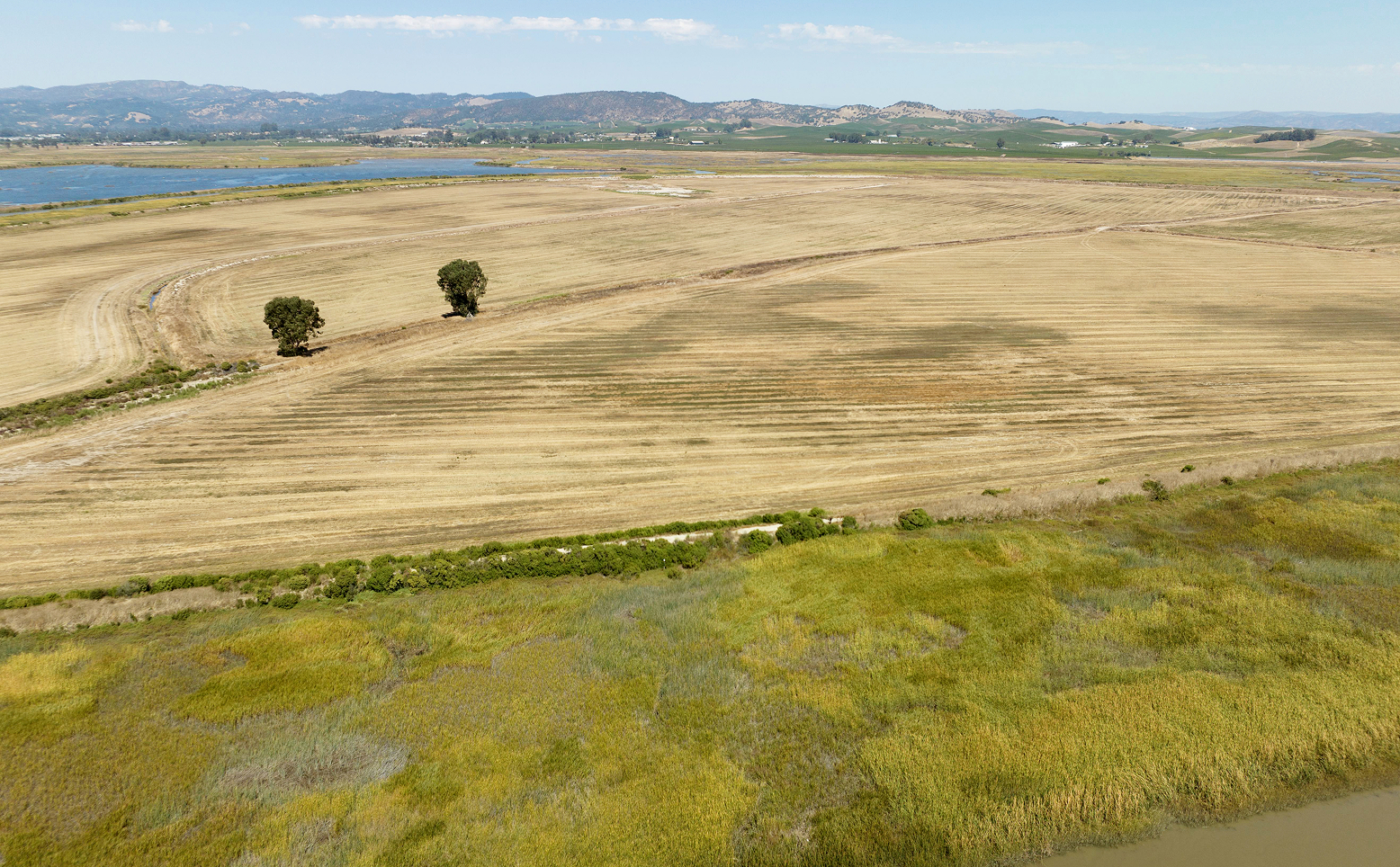
On September 5, Sonoma Land Trust, in partnership with the Natural Resources Conservation Service (NRCS), the San Francisco Bay Restoration Authority (Restoration Authority) and the Gordon and Betty Moore Foundation (Moore Foundation), purchased the 1,150-acre Camp 4 property on Ramal Road, a vital piece of the Sonoma Creek Baylands ecosystem. This collaborative effort marks significant progress toward the Land Trust’s strategic goal of permanently protecting and restoring 10,000 acres of baylands ecosystem. This will ensure our region greater resilience against sea level rise, and boost the conservation of threatened and endangered wildlife populations.
Situated in the heart of the Sonoma Creek Baylands, the property will be restored to tidal marsh wetlands after a century of agricultural use, most recently as an organic hay farm. Camp 4 sits between the San Pablo Bay National Wildlife Refuge and the Napa-Sonoma Marshes Wildlife Area, and is encircled by seven miles of tidal slough channels. This makes it an essential part of the broader wetland network which, when restored, will act as the most critical defense area against rising sea levels in the San Francisco Bay Area.
The partnership between Sonoma Land Trust and NRCS underscores their commitment to preserving natural landscapes. The collaboration’s primary goal is to secure the 1,150-acre property through a Wetland Reserve Easement (WRE) purchased by NRCS. The property’s underlying fee title will be acquired by the Land Trust, subject to the WRE. Sonoma Land Trust and NRCS will work hand-in-hand to design and implement a comprehensive tidal restoration plan, with the Land Trust taking on stewardship responsibilities for up to a decade, or until a suitable partner agency assumes ownership.
The acquisition and restoration of the Camp 4 property offers significant benefits for both the environment and the community:
- Wetland Expansion: This acquisition expands the protected wetlands area along San Pablo Bay by adding over 1,150 acres, further safeguarding the delicate ecosystem.
- Resilience Against Sea Level Rise: The restoration efforts contribute to the community and habitat’s resilience against the impacts of rising sea levels. The project aligns with Sonoma Land Trust’s Adapting to Rising Waters Strategy.
- Enhanced Habitat Diversity: Restoration of the 1,150-acre wetland habitat enhances San Francisco Bay’s biodiversity, providing a home for a diverse range of plants, fish, birds, and other wildlife.
- Critical Wildlife Populations: The Camp 4 property will serve as a vital habitat for special-status plants, fish, and wildlife, including the endangered Ridgway’s rail and salt marsh harvest mouse. Additionally, it will support hundreds of thousands of waterfowl and shorebirds along the Pacific Flyway, contributing to their conservation.
- Concentration of Waterfowl: The property will become home to more than 30 species of waterfowl, including a significant population of canvasback ducks—one of the largest concentrations in North America—and approximately 50 percent of the Pacific Flyway’s diving duck population.
How Camp 4 got its name:
In a report by historian Arthur Dawson, the Camp 4 property was one of many that was drained under the Swampland act of 1850, which provided the initial incentive for individuals to drain lands below the high tide line. It wasn’t until 1890 when this work shifted from human hands to steam-powered dredging machines that it really picked-up speed.
Around this time, Senator John P. Jones owned 15,000 acres (25 square miles) of Sonoma Valley’s tidelands and drained them for agricultural land. Jones set up six ‘Camps’ with bunkhouses to accommodate the workers on his ranch. As many as two hundred horses were used to work the land and were housed in huge barns. Hay was the most popular crop and was exported to San Francisco to fuel the horse-drawn carriages of that era.
Over time the converted tidelands dried out and the organic material in them decomposed, and they subsided as much as eight feet in elevation. In addition, these lands were no longer being replenished with sediment from tidal waters and upstream floodwaters from Sonoma Creek. Winter rains watered the dry farmed oat hay, but the levees prevented the floodwater from spreading across the landscape creating unintended upstream flooding. The first recorded flooding in the Schellville area occurred shortly after Jones’ dredges completed the first significant levee along Sonoma Creek in 1890.
Learn more about this property and to read the report by Athur Dawson, visit our webpage.On September 5, Sonoma Land Trust, in partnership with the Natural Resources Conservation Service (NRCS), the San Francisco Bay Restoration Authority (Restoration Authority) and the Gordon and Betty Moore Foundation (Moore Foundation), purchased the 1,150-acre Camp 4 property on Ramal Road, a vital piece of the Sonoma Creek Baylands ecosystem. This collaborative effort marks significant progress toward the Land Trust’s strategic goal of permanently protecting and restoring 10,000 acres of baylands ecosystem. This will ensure our region greater resilience against sea level rise, and boost the conservation of threatened and endangered wildlife populations.
Situated in the heart of the Sonoma Creek Baylands, the property will be restored to tidal marsh wetlands after a century of agricultural use, most recently as an organic hay farm. Camp 4 sits between the San Pablo Bay National Wildlife Refuge and the Napa-Sonoma Marshes Wildlife Area, and is encircled by seven miles of tidal slough channels. This makes it an essential part of the broader wetland network which, when restored, will act as the most critical defense area against rising sea levels in the San Francisco Bay Area.
The partnership between Sonoma Land Trust and NRCS underscores their commitment to preserving natural landscapes. The collaboration’s primary goal is to secure the 1,150-acre property through a Wetland Reserve Easement (WRE) purchased by NRCS. The property’s underlying fee title will be acquired by the Land Trust, subject to the WRE. Sonoma Land Trust and NRCS will work hand-in-hand to design and implement a comprehensive tidal restoration plan, with the Land Trust taking on stewardship responsibilities for up to a decade, or until a suitable partner agency assumes ownership.
The acquisition and restoration of the Camp 4 property offers significant benefits for both the environment and the community:
- Wetland Expansion: This acquisition expands the protected wetlands area along San Pablo Bay by adding over 1,150 acres, further safeguarding the delicate ecosystem.
- Resilience Against Sea Level Rise: The restoration efforts contribute to the community and habitat’s resilience against the impacts of rising sea levels. The project aligns with Sonoma Land Trust’s Adapting to Rising Waters Strategy.
- Enhanced Habitat Diversity: Restoration of the 1,150-acre wetland habitat enhances San Francisco Bay’s biodiversity, providing a home for a diverse range of plants, fish, birds, and other wildlife.
- Critical Wildlife Populations: The Camp 4 property will serve as a vital habitat for special-status plants, fish, and wildlife, including the endangered Ridgway’s rail and salt marsh harvest mouse. Additionally, it will support hundreds of thousands of waterfowl and shorebirds along the Pacific Flyway, contributing to their conservation.
- Concentration of Waterfowl: The property will become home to more than 30 species of waterfowl, including a significant population of canvasback ducks—one of the largest concentrations in North America—and approximately 50 percent of the Pacific Flyway’s diving duck population.
How Camp 4 got its name:
In a report by historian Arthur Dawson, the Camp 4 property was one of many that was drained under the Swampland act of 1850, which provided the initial incentive for individuals to drain lands below the high tide line. It wasn’t until 1890 when this work shifted from human hands to steam-powered dredging machines that it really picked-up speed.
Around this time, Senator John P. Jones owned 15,000 acres (25 square miles) of Sonoma Valley’s tidelands and drained them for agricultural land. Jones set up six ‘Camps’ with bunkhouses to accommodate the workers on his ranch. As many as two hundred horses were used to work the land and were housed in huge barns. Hay was the most popular crop and was exported to San Francisco to fuel the horse-drawn carriages of that era.
Over time the converted tidelands dried out and the organic material in them decomposed, and they subsided as much as eight feet in elevation. In addition, these lands were no longer being replenished with sediment from tidal waters and upstream floodwaters from Sonoma Creek. Winter rains watered the dry farmed oat hay, but the levees prevented the floodwater from spreading across the landscape creating unintended upstream flooding. The first recorded flooding in the Schellville area occurred shortly after Jones’ dredges completed the first significant levee along Sonoma Creek in 1890.
Learn more about this property and to read the report by Athur Dawson, visit our webpage.