Blog
interpretive planning: bringing it home
by Ingrid Spetz
So much of our modern world is based upon conveying information. As a species, we know more collectively now than we’ve ever known before, and that knowledge is growing exponentially. In a world with so much important information out there competing for our attention, how do we decide what to pay attention to? And what do we actually remember?
These were some of the questions that we pondered during a five-day interpretive planning workshop I attended last week in the Carmel River Valley. As interpreters of the natural world, our job is to help instill in others a love of nature and a desire to protect it. How we form that bridge between what people hold as their own highest, most closely-held values and the conservation work that we do is key to developing the support that is needed to continue this work into future generations.
One of the main points that David Bucy, long-time interpretive planner and instructor for the National Association for Interpretation, hammered into us was that people are constantly making choices about what to engage in based on their perceived benefit-to-cost ratio. How much is this going to “cost” me to pay attention to this message? How much is this going to benefit me if I do?
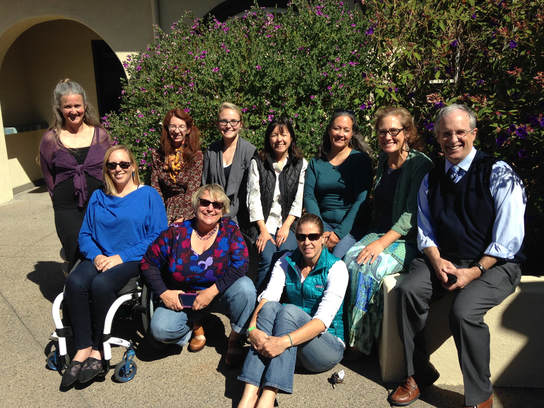
Process of Interpretive Planning workshop participants. Ingrid Spetz, top left. Instructor David Bucy, far right.
In this context, how do we determine what the “costs” are and what currency we are paying in? By and large, the most valuable currency that people spend is their time. We constantly make decisions about where to put our time (in the form of attention). Why should I spend my time paying attention to your message? What is in it for me and why should I care?
Those of us who value nature for nature’s sake already hold a deeply-held value that aligns with the conservation message. So we are more inclined to perceive a conservation message as being of high benefit to us and we might be willing to “pay” more to receive it. But even so, how many times have you skipped over a long scientific article about something you really think is valuable because it just seemed like too much effort to read? We all do it, right?
It is an interesting dance finding ways to convey information in a way that is enjoyable (low cost/high benefit) to the ones receiving the message — or, for that matter, in order for the message to even be received in the first place. The real test is asking whether what we put out there has inspired people to want to learn more about it.
At Sonoma Land Trust, we already have a large base of ardent supporters of our mission, in large part because our goals clearly align with each other’s values. If we really want to reach people outside of our core base, we will need to be willing to put ourselves out there and learn about what values people hold dear and use those as a lens for aligning our conservation message. I am excited about the potential we have to be really effective ambassadors for the natural world and it is going to be very interesting to see where we go with all of this over the years.
Join our interpretive staff “On the Land” and discover your personal connections with the wild lands of Sonoma County. More info at sonomalandtrust.org/outings
Those of us who value nature for nature’s sake already hold a deeply-held value that aligns with the conservation message. So we are more inclined to perceive a conservation message as being of high benefit to us and we might be willing to “pay” more to receive it. But even so, how many times have you skipped over a long scientific article about something you really think is valuable because it just seemed like too much effort to read? We all do it, right?
It is an interesting dance finding ways to convey information in a way that is enjoyable (low cost/high benefit) to the ones receiving the message — or, for that matter, in order for the message to even be received in the first place. The real test is asking whether what we put out there has inspired people to want to learn more about it.
At Sonoma Land Trust, we already have a large base of ardent supporters of our mission, in large part because our goals clearly align with each other’s values. If we really want to reach people outside of our core base, we will need to be willing to put ourselves out there and learn about what values people hold dear and use those as a lens for aligning our conservation message. I am excited about the potential we have to be really effective ambassadors for the natural world and it is going to be very interesting to see where we go with all of this over the years.
Join our interpretive staff “On the Land” and discover your personal connections with the wild lands of Sonoma County. More info at sonomalandtrust.org/outings
Ingrid Spetz is Sonoma Land Trust’s outings manager.