Blog
the land of falcons and eagles
by Shanti Edwards
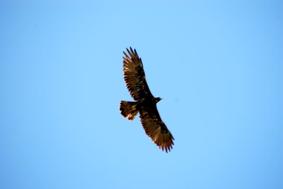
The sight of a golden eagle in flight, one of North America’s largest raptors, can make your heart soar and time seem to stand still — a momentous feeling that, if you are lucky enough, can be experienced at our Little Black Mountain and Pole Mountain Preserves. Thanks to the “eagle eyes” of neighbor Patrick Fisher and dedicated birders Larry Broderick and Diane Hichwa, a golden eagle nesting site has been documented on a large rocky outcrop of Little Black Mountain — the striking landmark for which the Land Trust’s property is named.
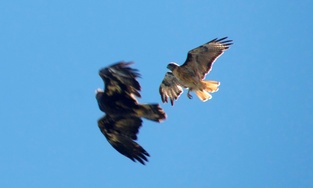
The Fisher family has a full vantage view of the rocky cliff face, so they’ve been observing and documenting eagle flight patterns and nesting behavior for decades. Some years are quiet with little activity, while other years see heightened activity with spectacular avian aerial acrobatics. Patrick captured these amazing photos of a golden eagle in flight (left) and a golden eagle/red-tailed hawk interaction (right).
The Fisher family has a full vantage view of the rocky cliff face, so they’ve been observing and documenting eagle flight patterns and nesting behavior for decades. Some years are quiet with little activity, while other years see heightened activity with spectacular avian aerial acrobatics. Patrick captured these amazing photos of a golden eagle in flight (left) and a golden eagle/red-tailed hawk interaction (right).
|
|
|
Last year Patrick spotted a peregrine falcon circling around the mountains. This spring he reported that falcons are now using the rocky nest site.
“After about two weeks of gazing constantly at the nest, with many different views of the peregrines, all activity seemed to have ceased. But then, by chance, yesterday we spotted one again… Not only that, but I’m looking at what looks like the male sitting in the nest with what appears to be two smaller white shapes bobbing around. After reading up a little more, it seems plausible that the timing is about right and if they are young hatchlings, they might be nearing their first flight!”
More recently, Patrick noted: “It’s been really active with the falcon family. We hear one constantly, from sunup to sundown many days as it squeals and sings … I’ve seen them going in and out of the nest, and perching all over the rocks facing this side of the mountain. It seems like we’ve gone from the land of eagles to the land of falcons! Then, recently, the eagles showed up above the peak of Little Black, thankfully.”
Last year Patrick spotted a peregrine falcon circling around the mountains. This spring he reported that falcons are now using the rocky nest site.
“After about two weeks of gazing constantly at the nest, with many different views of the peregrines, all activity seemed to have ceased. But then, by chance, yesterday we spotted one again… Not only that, but I’m looking at what looks like the male sitting in the nest with what appears to be two smaller white shapes bobbing around. After reading up a little more, it seems plausible that the timing is about right and if they are young hatchlings, they might be nearing their first flight!”
More recently, Patrick noted: “It’s been really active with the falcon family. We hear one constantly, from sunup to sundown many days as it squeals and sings … I’ve seen them going in and out of the nest, and perching all over the rocks facing this side of the mountain. It seems like we’ve gone from the land of eagles to the land of falcons! Then, recently, the eagles showed up above the peak of Little Black, thankfully.”
|
The golden eagles (Aquila chrysaetos) are majestic birds of prey with ruddy dark brown bodies and golden-brown feathers on the back of their head and neck, with wingspans up to eight feet. They utilize hunting territories up to 60 square miles in size and prey upon a variety of small mammals such as rabbits and squirrels. They are known to seek out high rocky cliff faces near hunting grounds for nest sites. Historically impacted by habitat destruction and poisoning, golden eagles are a species of special concern now legally protected under the Bald and Golden Eagle Protection Act.
|

|
Peregrine falcons (Falco peregrinus) are the fighter jets of the bird world, renowned for their high speed dive known as a “stoop” in which they can reach speeds of 240 mph. Peregrine falcons typically feed on mid-sized birds and bats that they catch mid-air. They mate for life and nest in a “scrape” (shallow depression) atop cliffs and human-made structures. Peregrines are a species of least concern that has rebounded after a population crash in the 1960s (caused by that once widely used pesticide, DDT).
Regarding golden eagle/peregrine falcon nest site interactions, raptor identification specialist (aka raptor magnet) Larry Broderick writes: “Golden eagle (GOEA), red-tailed hawk (RTHA) and peregrine falcon (PEFA) will all use vacant nest scrapes if they are available. Birds of prey tend to have more than one nest or scrape location and typically rotate due to a few variables: seasonal changes, prey availability, nest mite infestation, mold or nest disrepair. So if the Little Black Mountain site is not occupied by a GOEA pair, it is highly probable that a PEFA pair could and would use it. Local birders have seen less GOEA breeding in the Sonoma County Coastal region and increased PEFA breeding, so this all makes sense. However, unguarded or unprotected peregrine chicks and fledglings could fall prey to the golden eagles if the parents aren’t vigilant or the young PEFA’s first flights are in the sights of the GOEAs.”
It is thanks to friends and supporters like you, that places like Little Black Mountain and Pole Mountain are protected forever. And it is thanks to friends like Patrick Fisher and Larry Broderick who document and share the natural history of this incredible landscape, enriching our sense of place and providing us with a deeper understanding of the flora and fauna with which we share this world. If you’d like to explore this wild landscape or join a raptor hike with Larry Broderick this fall, keep checking our outings schedule here.
Regarding golden eagle/peregrine falcon nest site interactions, raptor identification specialist (aka raptor magnet) Larry Broderick writes: “Golden eagle (GOEA), red-tailed hawk (RTHA) and peregrine falcon (PEFA) will all use vacant nest scrapes if they are available. Birds of prey tend to have more than one nest or scrape location and typically rotate due to a few variables: seasonal changes, prey availability, nest mite infestation, mold or nest disrepair. So if the Little Black Mountain site is not occupied by a GOEA pair, it is highly probable that a PEFA pair could and would use it. Local birders have seen less GOEA breeding in the Sonoma County Coastal region and increased PEFA breeding, so this all makes sense. However, unguarded or unprotected peregrine chicks and fledglings could fall prey to the golden eagles if the parents aren’t vigilant or the young PEFA’s first flights are in the sights of the GOEAs.”
It is thanks to friends and supporters like you, that places like Little Black Mountain and Pole Mountain are protected forever. And it is thanks to friends like Patrick Fisher and Larry Broderick who document and share the natural history of this incredible landscape, enriching our sense of place and providing us with a deeper understanding of the flora and fauna with which we share this world. If you’d like to explore this wild landscape or join a raptor hike with Larry Broderick this fall, keep checking our outings schedule here.
Shanti Edwards is Sonoma Land Trust’s stewardship project manager.