Blog
Six Sonoma Species to Seek this Summer
Spending Summer with a Sonoma Naturalist
Very few people know Sonoma’s wildlife like Naturalist Sarah Reid. Having cataloged over 67,000 observations on iNaturalist and spending her career on the land, she is our go-to resource for identifying the flora and fauna in our region. She has shared six species that you may discover in your summertime adventures. Have you spotted these species?
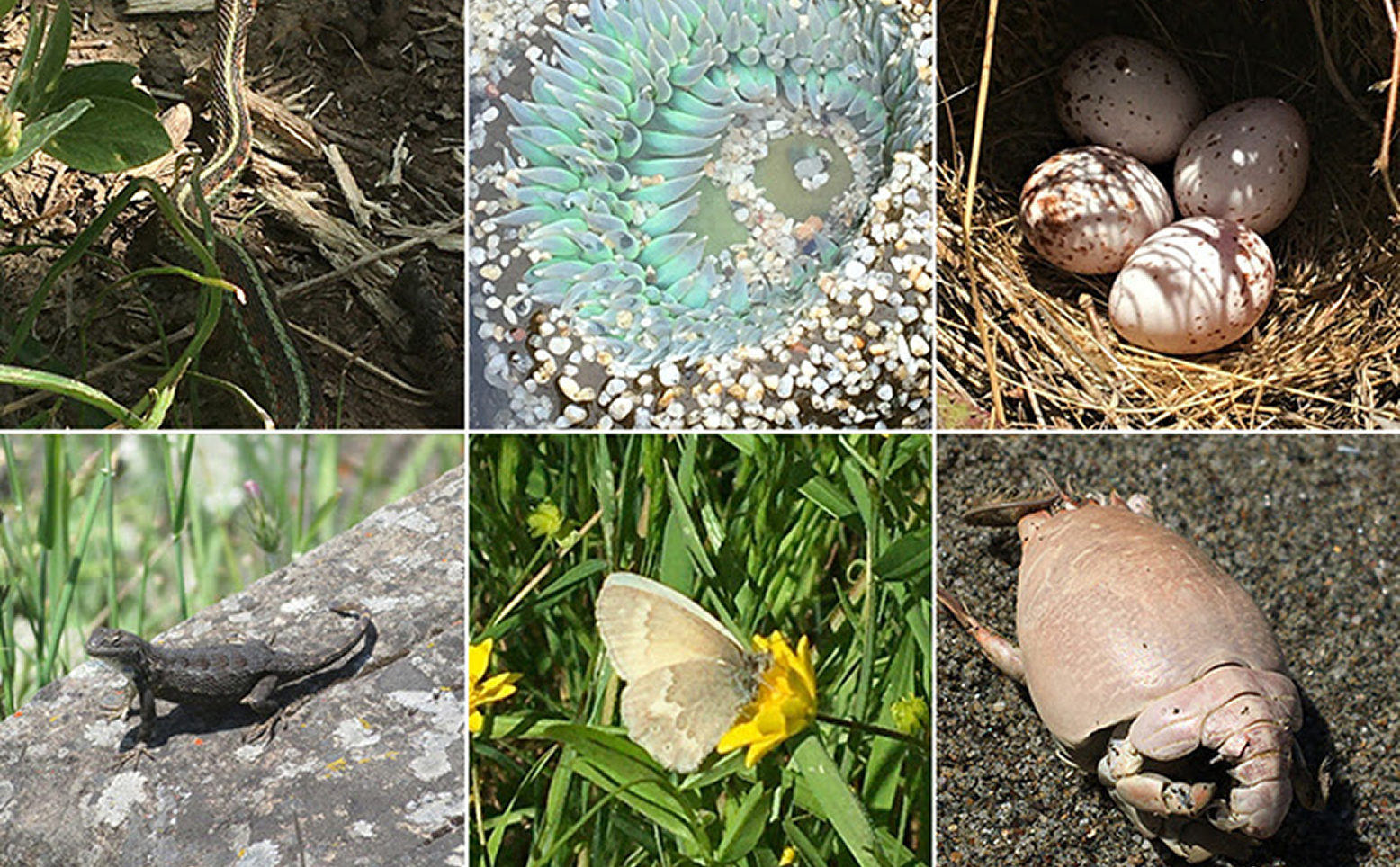
Ever seen a lizard doing push-ups? This is likely a male Western Fence Lizard (Sceloporus occidentalis) or “Blue-Belly” attracting a female. Fun fact: these unassuming reptiles carry a blood enzyme that when a Lyme-disease infected tick bites the lizard, the lizard’s enzyme kills the Lyme bacteria in the tick! This is important because ticks like to hitch a ride in the lizard’s ears.
Along the ocean shore in the “swash” (water that washes up on the beach after an incoming wave has broken) you may have seen little holes in the sand made by the clawless sand crabs go. These camouflaged crustaceans (Emerita analoga) are no bigger than your thumb and move their bodies backwards to burrow into the sand. Factoid: this crab is an indicator species for monitoring a kind of acid-synthesizing diatoms that can cause toxic blooms and are helpful in neurological studies because the crabs’ tails have the largest sensory neurons found in any animal.
California Red-sided Garter Snakes (Thamnophis sirtalis infernalis) are slightly bigger than pencil-width. These slitherers are fast-moving so you might only catch a glimpse of the red stripe down its body. Don’t worry: these pose no danger to humans, but they have evolved to digest the toxic Pacific Newt and not get sick. These snakes are 18-55” long.
Mama Savannah Sparrow (Passerculus sandichensis) is a tiny little bird, only 4-6”. She takes her chances making a ground nest in grasslands. Her song floats up from her hiding spots deep in the grasses in high pitch chirps. If you accidently step near her nest, she will grab your attention by jumping up to distract you and lead you away from her precious eggs.
Look along the tide-line at the ocean and you can’t miss the Giant Green Anemone (Anthopleura xanthogrammica) either floating its tentacles out in search of food, or closed-up tight when the tide goes out. As a developing youth, once it attaches itself to a rock it stays there. If it’s lucky, it bonds to a hold in community of mussels where food is plentiful.
Walking through grasslands you might notice little fairies flitting up in front of you. These are butterflies and moths, in a variety of colors and patterns. The Common Ringlet (Coenonympha tullia) is, well, common. Common yet delicately precious. But watch carefully when it lands: if you blink you won’t see it again, because it blends in so well with its surroundings! It likes grasslands, including roadsides, woodlands and edges, prairies and bogs. So it’s likely you have seen them frequently, like they are leading the way down the path.