Blog
Our relationship with fire… it’s complicated
by Corby Hines
Kat Anderson’s seminal book “Tending the Wild” on the Native American knowledge and management of the California landscape, describes fire as “the most significant, effective, efficient and widely employed vegetation management tool of California Indian tribes.”
“Deliberate burning increased the abundance and density of edible tubers, greens, fruits, seeds and mushrooms; enhanced feed for wildlife; controlled the insects and diseases that could damage wild foods and basketry material … It also removed dead material and promoted growth through the recycling of nutrients and decreased plant competition, and maintained specific plant community types, such as coastal prairies and montane meadows.” Living near the coast, I see the endangered coastal prairie habitat transforming into scrubland and forest in the absence of regular burning. Historically, regular and deliberate burning was the norm.
Lucy Lewis of the Pomo recalled that “The valleys were filled more or less with large oaks. The grass burned each year [by the Pomo]. The brush would burn. Trees were just scorched. Fires were started, and they were just allowed to burn every place. Special spots were prepared to serve as safe spots. Game was caught this way. The big trees were not killed … Burning was to make the grass grow better. Brush was kept down. All forests were burnt out.”
Anthropologist Alfred Kroeber’s 1939 field notes record that “the Yurok of northwestern California practiced burning at a frequency that was appropriate for each cultural purpose: burning of hazelnut for basketry occurred every two years; burning under the tan oaks to keep the brush down took place every three years; burning for elk feed occurred every fourth of fifth year; burning in the redwoods for brush and downed fuel control occurred every three to five years.”
“Lucy Thompson, a prominent Yurok basket weaver, notes that the Douglas fir timber has always encroached on the open prairies and crowded out the other timber; therefore, they have continuously burned it and done all they could to keep it from covering all the open lands.”
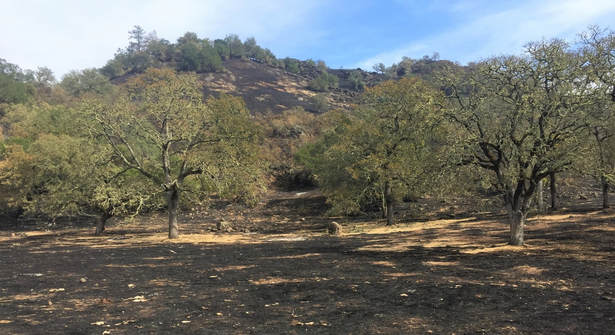
While the fires were raging near Santa Rosa, I looked at the tan oak and fir forest behind my house with trepidation, as many of the trees were dead or dying with large amounts of brush in the understory. It certainly hadn’t experienced the historic three-year deliberate burn cycle in a long while. If a fire did come through there, it would almost certainly be a catastrophic crown fire. Needless to say, I’ve been thinning the weaker trees and clearing brush with a new sense of urgency since the thick smoke filled the air.
James Rust, of Southern Sierra Miwok, recalls that, “There was nothing in those days to burn. The fires wouldn’t get away from you or take all the timber like it would now. It wouldn’t burn the Black Oaks, only the grass underneath.”
Nowadays, the fires do get away from us and there is plenty to burn. Without understanding the historic role of humans in the fire ecology of California, we will continue to experience this cycle of catastrophic fire, as this Press Democrat article from 2013 so eerily predicted.
The forest conditions of today are a far cry from what they were a few hundred years ago. The density of trees in our forests is far greater and, along with a warming climate, this has stressed the health of the forest to a critical point. In addition, there are far more people living in or near these forests, which prohibits utilizing the kind of fire regime used by the Native Californians in the past. However, as we adapt to our new reality and understandings, the principles of how the Native Californians tended to the land — with understanding and reverence — are becoming more prevalent. Pepperwood Preserve was heavily burned in the recent wildfires, but it appears that the cattle survived by taking refuge in an area that had been deliberately burned in the spring.
The people of Sonoma County have long demonstrated their resiliency in the face of adversity. Even as we are still coming to grips with the damage done by the wildfires, Sonoma Land Trust volunteers and members are coming out in droves to offer their help in restoring the land and aiding the people who experienced such terrible loss. Although we will continue to live with fire, just as the people of this land always have, we can certainly change how we relate to it and create a relationship that benefits both the land and life. Controlled fire can be one of many tools we use on the path to creating healthy forests in our region. Now is the time to apply what we know and fully take on our historic role as stewards of the land and tenders of the wild.