Blog
a good day for the mountain
by Shanti Edwards
“We are good at putting out average fires, but we are trending toward catastrophic events driven by weather conditions. History did repeat itself and will again,” he warns. “The large fires of 1964 and 1978 are just one generation away and people forget — but we can’t forget.”
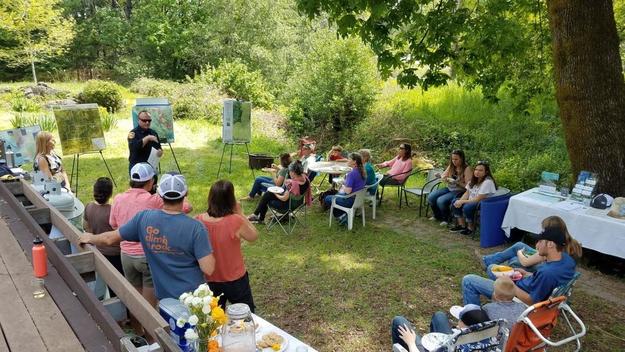
We took Marshall’s guidance to heart and recently convened a gathering to connect with Cazadero neighbors who live near Sonoma Land Trust’s Little Black Mountain and Pole Mountain Preserves. This was a rare opportunity to share a conversation as a group about emergency notification systems, potential evacuation routes, fuel reduction strategies and all things relevant to our rural mountain community. Marshall was in attendance to provide expert advice for defensible space and emergency response planning, and Jeff Schreiber of Sonoma RCD introduced landowner assistance programs for fuel reduction and road improvement.
Over the years, the Land Trust has focused on fuel reduction projects (in partnership with CAL FIRE, Conservation Corps North Bay, USDA and FireSafe Sonoma) to improve forest health and wildlife habitat, and maintain defensible space and emergency access corridors at the Little Black Mountain Preserve. We installed water storage tanks with hydrant outlets and developed a fire preparedness plan and map for the local fire department. These efforts are necessary in a thickly forested landscape recovering from the intensive logging of the 1950s and the forest-stand replacing fire of 1978 — and continue to be a high stewardship priority today.
We are actively managing our forests and grasslands for ecological integrity and wildfire resiliency. As fire ecologists distill their recommendations, we’ll be applying those lessons learned across our protected lands.
For more information about defensible space recommendations, please go to: