Blog
an ice dream
by Corby Hines
living through the ice age and global warming
Perspective is important. As a photographer, I’ve noticed that even a small move to reframe your subject can have a dramatic effect on the outcome of your picture.
With the recent National Climate Assessment, it’s easy to get depressed or even succumb to despair with the dire warnings of change and upheaval that we can expect with a rapidly warming climate. Our current picture of the earth’s climate future and our role in it is pretty dark.
However, a simple shift in perspective to reframe the subject will open up whole new possibilities. So, let’s take a wider view of earth’s climate and see global warming in a new light — by imagining something even worse! Let’s imagine what living through an ice age would be like!
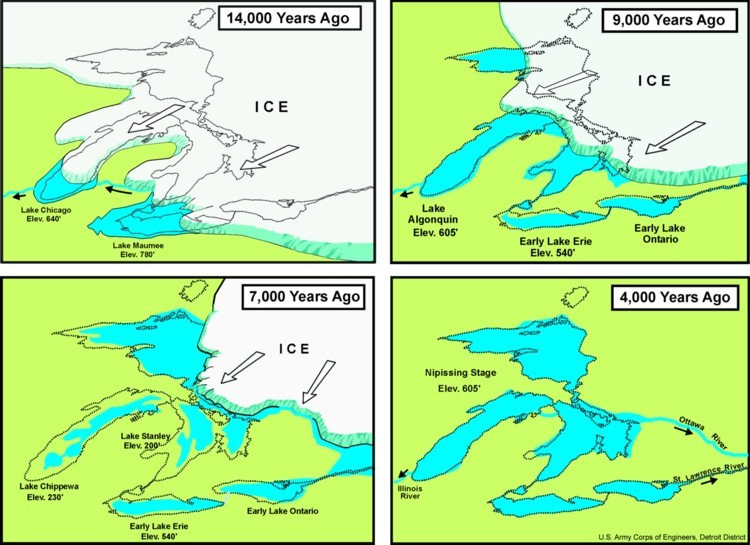
Yes, that’s right, imagine one third of the earth’s land surface covered in ice sheets a mile thick. Imagine Chicago, Detroit, Cleveland and New York scraped off the map (I think my hometown of Buffalo would be fine). It’s so cold and dry that agriculture at our latitudes is all but impossible and our food system collapses. Sea levels drop by 400 feet, land-locking the world’s great harbors. Imagine Canadians and Americans heading south to seek refuge in Mexico!

Now this scenario may seem far-fetched, but the reality is that we are already in an ice age — the Quaternary — and have been for the last 2.6 million years and counting. An ice age is defined by at least one permanent ice sheet and currently, we have two. The earth has experienced four previous ice ages, lasting anywhere from 30–300 million years! During an ice age, the climate isn’t uniformly cold and dry the whole time — it oscillates between glaciations and interglacials. During a glaciation, 30 percent of the earth’s land surface may be buried beneath ice sheets for nearly 100,000 years, followed by a much shorter interglacial. The last 11,000 years is the current interglacial and the period in which humanity discovered agriculture and civilization, and exponentially expanded our population. Before that, during the previous long glaciation, we were hunter-gatherers following migrating herds of caribou, mammoths and mastodons. We found exposed land bridges giving access to new continents while we kept watch for saber-toothed tigers, dire wolves and giant cave bears.

Through studying ancient ice cores and deep ocean sediments, we have evidence that the Quaternary Period has seen 60 glacial/interglacial cycles in the last 2.6 million years. The following graph depicts the climate over the last 450,000 years.

If the previous pattern continues, can we expect an end to the relative stability of this current interglacial and a coming 100,000-year winter? Or is our addiction to burning fossil fuels warming our planet so fast that we and other precious species won’t be able to adapt in time?
Time will tell, but one thing’s for sure: This stable period in the earth’s climate is nothing to take for granted and we’ve got to do all we can to prevent a human-caused catastrophe. In the meantime, I’ve decided to reduce my carbon footprint and get a snow suit. Instead of depression or despair, I marvel at life’s amazing adaptability to the wild challenges of living here on this dynamic, blue marble in the vast frontier of space.
Time will tell, but one thing’s for sure: This stable period in the earth’s climate is nothing to take for granted and we’ve got to do all we can to prevent a human-caused catastrophe. In the meantime, I’ve decided to reduce my carbon footprint and get a snow suit. Instead of depression or despair, I marvel at life’s amazing adaptability to the wild challenges of living here on this dynamic, blue marble in the vast frontier of space.

Corby Hines is Sonoma Land Trust’s outings guide, photographer and videographer.