Blog
unseen wilderness
by Julian Meisler
The bay’s underwater ecosystem is a veritable wilderness full of sharks, rays and fish of all sizes. The more I learn, the more appreciative I become of the habitat that Sears Point provides now and into the future.
Recently, I was fortunate to be part of a group that included staff from SLT, Ducks Unlimited, and the National Oceanic and Atmospheric Administration on a boat trip from the lower Petaluma River into the restored Sears Point tidal restoration area. Our group was led by consultants who were demonstrating equipment that would enable us to see firsthand the life beneath the murky bay water. It’s a technology driven by sonar that, unlike a fish finder, enables us to look tens of meters horizontally through the water column instead of simply straight down.
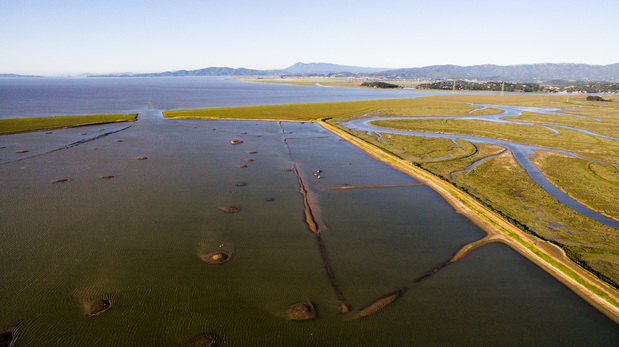
It’s important for us to know what marine life is present and how they are using the site so we better understand its habitat value as it matures into a tidal marsh. We have questions about some of the interesting physical features that make up the site. For instance, are fish interested in the topographic relief provided by the five hundred marsh mounds? How do they use the six miles of excavated channels? Do they hide in the cover of the 30 tree stumps that we embedded in the sides of the channels? What about the acreage that was covered in coyote brush before we flooded it? Are those woody skeletons providing habitat? All of these questions can inform how we design future projects.
But sampling fish is not easy in murky salt water with so many logs and stumps that might snag a net. We hoped that the new sonar equipment would provide a glimpse of what is there — and indeed it did.
We saw dense schools of fish whose behavior and movement resembled flocks of shorebirds. We watched predatory fish nearly two feet in length as they followed and attacked the smaller schools. While my untrained eye couldn’t tell what species these were, even I could identify the graceful flapping wings of the bat ray which glided through our field of view multiple times. Check it out below.
Have a look for yourself. You might not see a sturgeon, but you might glimpse an otter, a harbor seal or even an errant elephant seal. What’s certain is that there is, indeed, a wilderness beneath the sea surface. We have wonderful interpretive signs along the trails and will soon launch an audio tour accessible from your mobile device. Perhaps, best of all, our docents are on the levee with spotting scopes and a wealth of knowledge every Saturday morning from 9am to noon. We hope to see you there, too.
Julian Meisler is Sonoma Land Trust’s Baylands program manager.