Blog
ticks: lyme-ing in wait
by Kyle Pinjuv
Hiking season has arrived in Sonoma County. In fact, every season is hiking season in Sonoma County —we are lucky in that way! But hiking season also means tick season, and every season is tick season in Sonoma County. We are unlucky in that way. Our county is home to a variety of tick species, and knowing how to identify them, their behavior and how to deal with them is very important for your short and long-term health. Sounds dramatic, I know, but as a vector species, these small arthropods can transmit a number of diseases to their hosts (hosts being Sonoma County hikers, bikers, our pets, and others). Lyme disease, Rocky Mountain spotted fever, tick-borne relapsing fever, tularemia, babesiosis, anaplasmosis and ehrlichiosis are among the diseases that can be transmitted from a single tick bite, Lyme disease being the most common.
Photo credit: www.cdc.gov
Ticks are often found hanging on the edge of a blade of grass, front legs outstretched, waiting for a host to walk by and brush against them so they can grab hold. At this point, they will begin their journey up and over your clothing, or an animal’s fur, until they find a suitable place to dig in for a meal. For humans, that place is usually at the interface between clothing and skin. Your sock lines, belt lines or collars are all common places for tick attachment. It is a misconception that ticks fall from trees or that they can jump onto their hosts. In actuality, if you find them on your neckline or scalp, they likely made a long journey from your boots or pants cuffs. Tucking the cuffs of your pants into your socks and your shirt into your pants can help keep ticks from finding bare skin.

Photo credit: www.grit.com
After hiking, gardening or even just walking the dog in areas where ticks might be present, it is a good idea to inspect your clothing and exposed skin for any stowaways. If you do find a tick attached to your skin, it is important to remove it quickly and properly:
- Use fine-tipped tweezers to grasp the tick as close to the skin’s surface as possible.
- Pull outward with steady, even pressure.
- After removing the tick, thoroughly clean the bite area and your hands with rubbing alcohol, an iodine scrub, or soap and water.
Trying to suffocate ticks with peanut butter or Vaseline, burning them with a match head, or twisting them out can actually force the tick to regurgitate or leave tick parts embedded in your skin — both recipes for infection.

Photo credit: www.cdc.gov
Ticks and Lyme disease
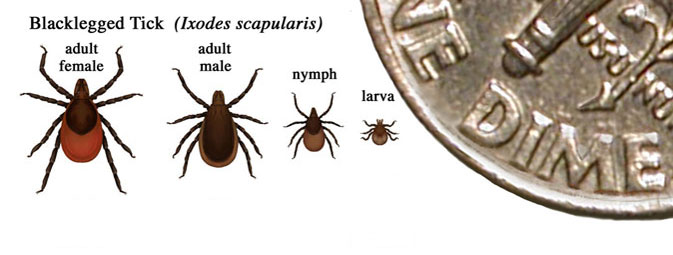
Sonoma County has one of the highest rates of confirmed Lyme disease infections in California, and shares this unfortunate title with Mendocino and Humboldt Counties. Lyme disease in the Pacific Region of the US enters the body from a bacterium found in the western blacklegged tick (Ixodes pacificus). According to the Centers for Disease Control (CDC), ticks containing the Lyme bacterium must be attached for 36 to 48 hours before Lyme disease can be transmitted. Most infections occur through bites of immature ticks called nymphs. This is simply because nymphs are much smaller than adults and less likely to be discovered in time to remove and avoid infection. According to multiple surveys, Annadel, Sugarloaf Ridge and Jack London State Parks all have Lyme-infected tick populations ranging between 4.5 and 7.3 percent of nymph and adult blacklegged ticks.
Although the bacteria Borrelia burgdorferi was not officially classified until the early 1980s, and contrary to the conspiracy theory that the disease was created by Nazi scientists off the coast of Connecticut (a real theory — and worth a quick web search), the disease is likely to have existed for thousands of years. It didn’t begin to gain attention until the 1970s, when in Lyme, Connecticut, a growing number of children and adults suffered from a similar set of debilitating symptoms. Since the 1970s, reported Lyme cases have dramatically increased. Today, Lyme disease is one of the fastest growing vector-born infections in the US.
There isn’t enough space in this blog to list all the important information regarding ticks and tick-borne illnesses, so below are some links I encourage you to read before your next hike in our beautiful county!
CDC page on Lyme disease
https://www.cdc.gov/lyme/index.html
Sonoma County Public Health Assessment and Wellness information on ticks
http://sonoma.networkofcare.org/ph/library/article.aspx?hwid=tp23585spe
Sonoma County has one of the highest rates of confirmed Lyme disease infections in California, and shares this unfortunate title with Mendocino and Humboldt Counties. Lyme disease in the Pacific Region of the US enters the body from a bacterium found in the western blacklegged tick (Ixodes pacificus). According to the Centers for Disease Control (CDC), ticks containing the Lyme bacterium must be attached for 36 to 48 hours before Lyme disease can be transmitted. Most infections occur through bites of immature ticks called nymphs. This is simply because nymphs are much smaller than adults and less likely to be discovered in time to remove and avoid infection. According to multiple surveys, Annadel, Sugarloaf Ridge and Jack London State Parks all have Lyme-infected tick populations ranging between 4.5 and 7.3 percent of nymph and adult blacklegged ticks.
Although the bacteria Borrelia burgdorferi was not officially classified until the early 1980s, and contrary to the conspiracy theory that the disease was created by Nazi scientists off the coast of Connecticut (a real theory — and worth a quick web search), the disease is likely to have existed for thousands of years. It didn’t begin to gain attention until the 1970s, when in Lyme, Connecticut, a growing number of children and adults suffered from a similar set of debilitating symptoms. Since the 1970s, reported Lyme cases have dramatically increased. Today, Lyme disease is one of the fastest growing vector-born infections in the US.
There isn’t enough space in this blog to list all the important information regarding ticks and tick-borne illnesses, so below are some links I encourage you to read before your next hike in our beautiful county!
CDC page on Lyme disease
https://www.cdc.gov/lyme/index.html
Sonoma County Public Health Assessment and Wellness information on ticks
http://sonoma.networkofcare.org/ph/library/article.aspx?hwid=tp23585spe
Kyle Pinjuv is a stewardship assistant project manager at Sonoma Land Trust.