Blog
the language of birds
by Corby Hines
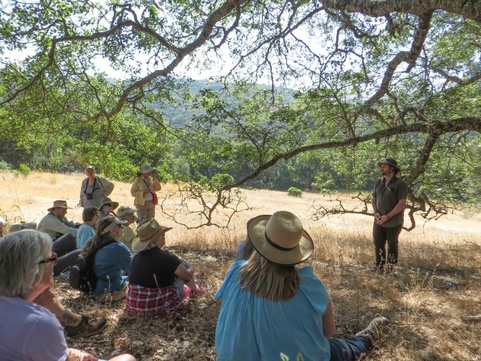
Sonoma Land Trust recently hosted a bird language workshop at our Glen Oaks Ranch Preserve, opening my eyes (and ears) to an amazing new world. While we sat under the wide canopy of an ancient oak tree, our instructor Jay Markert revealed the wealth of information that birds communicate to everyone who cares to listen.
Birds are the sentries of the forest. With an aerial (and therefore expansive) view of their surroundings, they’re provided with advanced knowledge of the comings and goings of other animals in the area. Survival requires birds, like all wild animals, to be alert to any potential dangers, including predators like bobcats on the ground or hawks in the air. Birds vocalize to each other about these dangers, but also vocalize to communicate more mundane aspects of daily life. Jay, who learned bird language from the tracker and naturalist Jon Young (author of the book What the Robin Knows), shared with us the five voices that birds use:
- Song: the unique melody different species employ — to attract a mate, herald the dawn or maybe like us, to sing for the sheer joy of it
- Companion calls: a call and response rhythm that allows pairs or groups of birds to keep tabs on one another
- Juvenile begging: repetitive calls that baby birds use to beg for food
- Territorial aggression: used by one species to drive rivals of the same species out of their territory
- Alarm Calls: higher-pitched and intense vocalizations to alert others to a potential threat

Photo by Roger Marlowe.
The first four calls are considered baseline calls. During these calls, nothing is out of the ordinary — no life-threatening dangers are present. For example, rival robins might be having a dispute and vocalize their territorial aggression, but the sparrows would remain unconcerned for their safety and keep whistling away. Alarm calls, however, no matter the species, will immediately capture everyone’s attention. Many of us have noticed local songbirds chirping to each other while on the ground feeding, then all suddenly fly up to the nearest branch and emit harsh alarm calls at a house cat entering the scene. Silence is another form of alarm. When all songs suddenly stop and the forest becomes eerily silent, keep your eyes peeled for a sharp-shinned hawk or kestrel who might be rocketing past.
The first four calls are considered baseline calls. During these calls, nothing is out of the ordinary — no life-threatening dangers are present. For example, rival robins might be having a dispute and vocalize their territorial aggression, but the sparrows would remain unconcerned for their safety and keep whistling away. Alarm calls, however, no matter the species, will immediately capture everyone’s attention. Many of us have noticed local songbirds chirping to each other while on the ground feeding, then all suddenly fly up to the nearest branch and emit harsh alarm calls at a house cat entering the scene. Silence is another form of alarm. When all songs suddenly stop and the forest becomes eerily silent, keep your eyes peeled for a sharp-shinned hawk or kestrel who might be rocketing past.

After taking in this new knowledge, our group split up to find our own spots to sit and practice listening to the birds. What many of us realized is that we, as humans, are part of the birds’ stories. As I got up from our makeshift classroom under the oak and made my way alone down a forested path to find my sit spot, I found to my delight that a Steller’s jay was following me — and alerting the other birds to my presence. After sitting still for some time, the birds around me returned to their normal routine, which brought me into a quiet reverie, appreciative of our deep connections with the fabric of life.
If you’d like to hear some examples of the various voices that birds use, click here. Better yet, get outside and listen to what the birds are saying about your neighborhood!
If you’d like to hear some examples of the various voices that birds use, click here. Better yet, get outside and listen to what the birds are saying about your neighborhood!