Blog
“scent-ual” healing
by Kate Freeman
On a recent afternoon at Glen Oaks Ranch, the allure of feeling alone in the woods fueled my desire to linger until dusk. I slowly wound my way down the George Ellman Trail, savoring the rich blanket of green that is once again spreading out over the landscape. In a momentary respite from the cacophony of robins and starlings that are flocking in massive numbers around the farmstead, I savored the stillness and solitude of wintertime. Just as my mind began to quiet, I was caught off guard by a pungent gust of skunk musk coming from above. Looking up, I saw not a skunk but a Great Horned Owl passing silently overhead, unintentionally broadcasting its presence like the lovesick Pepé le Pew.
I’ve seen many skunks here in Sonoma: Striped Skunks or Mephitis mephitis (meaning something like foul stench or noxious vapor) are native to the United States and widespread. As you may have seen in Tony Nelson’s latest blog on possums, skunks often show up on our wildlife cameras and are rarely intimidated by other animals. Luckily for me, when I ran into a skunk this summer while crawling through a blackberry thicket (my incentive for doing so may be the inspiration for a future blog post), it was a head-on collision. I seem to predominantly find skunks as roadkill, and research indicates that automobiles and disease kill more skunks than all of their predators combined. While mountain lions, bobcats, foxes, badgers and coyotes will prey on skunks — although I imagine these hunters would have to be hungrier than a bird during migration to go after a skunk — large raptors, specifically Great Horned Owls, are the primary predator.
Despite the fact that the average Striped Skunk weighs 6−8 pounds and has a potent system of self-defense, Great Horned Owls, weighing in at about three pounds, consume skunks with regularity. The longstanding assumption that birds lack a sense of smell is turning out to be myth as current studies reveal that birds have a high number of active olfactory genes. So although Great Horned Owls probably do experience scent, they may find skunk musk more akin to delicious stinky cheese than putrid flowers left to sit in the vase too long. In any case, a skunk’s most notorious and effective defense mechanism is powerless against predators striking from the sky.
Despite the fact that the average Striped Skunk weighs 6−8 pounds and has a potent system of self-defense, Great Horned Owls, weighing in at about three pounds, consume skunks with regularity. The longstanding assumption that birds lack a sense of smell is turning out to be myth as current studies reveal that birds have a high number of active olfactory genes. So although Great Horned Owls probably do experience scent, they may find skunk musk more akin to delicious stinky cheese than putrid flowers left to sit in the vase too long. In any case, a skunk’s most notorious and effective defense mechanism is powerless against predators striking from the sky.

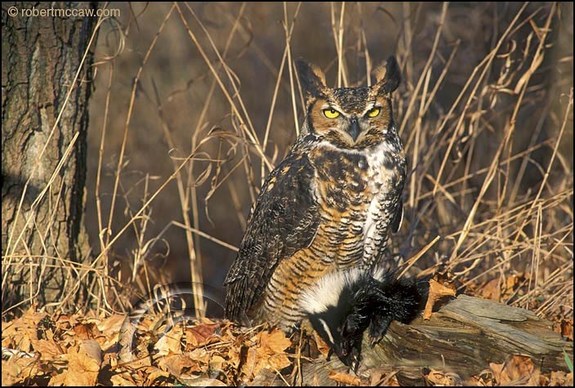
A Great Horned Owl, fiercely perched with its aromatic dinner. Photo credit: Robert McCaw
Regardless of whether you’re a bird nerd like me, you certainly will agree that the Great Horned Owl is a formidable predator. Most are familiar with these majestic creatures of the night — with their glowing yellow eyes, feathered “horns” and deep hooting voice, they are easily distinguishable. A killer combination of keen eyesight, impeccable hearing and silent flight make owls a triple threat when it comes to nocturnal hunting. Much of this hunting prowess is due to the special adaptations of an owl’s flight and body feathers. The groups of feathers around their head, called facial disks, help direct sound to their ears. Additionally, their flight feathers are streamlined to act as silencers. Comb-like serrations on the leading edge and soft fringe on a wing’s trailing edge break up the turbulent air that typically creates a swooshing sound when birds fly). Those poor, unsuspecting skunks don’t even get the slightest hint of a flapping wingbeat before they meet their demise.

This close of photo of a Great Horned Owl primary feather shows the comb-like leading edge, an adaptation to help muffle the sound of wind on the wings in flight. Photo credit: Global Owl Project.
While the only evidence of skunk I had that evening came from the deeply perfumed underbritches of a recently sated owl, I couldn’t help but feel delighted by the infinite number of ecological interactions occurring above, below and all around me at any given moment. Admittedly, being blasted by the stench of owl feathers steeped in skunk musk was a powerful reminder to re-awaken my senses in 2018 and become ever more perceptive to the phenomenal expressions of life right under my nose.
Sources
Deal, K. H. (2010). Wildlife and Natural Resource Management. Cengage Learning: New York, NY.
Ogden, L. E. (2017). The Silent Flight of Owls, Explained. National Audubon Society, http://www.audubon.org/news/the-silent-flight-owls-explained
Sources
Deal, K. H. (2010). Wildlife and Natural Resource Management. Cengage Learning: New York, NY.
Ogden, L. E. (2017). The Silent Flight of Owls, Explained. National Audubon Society, http://www.audubon.org/news/the-silent-flight-owls-explained
Kate Freeman is Sonoma Land Trust’s stewardship assistant project manager