Blog
revelations in the desert
by Corby Hines
What is an interpretive guide, you ask? Interpretation is the art of communicating the science of nature in ways that people can appreciate and understand. An interpretive guide should be able to relate the place to the audience, creating emotional and intellectual connections between the people and the land. It’s not just about providing information — it’s also about provoking revelations.
My own revelation occurred during the final day of the training when we toured a remote canyon in the desert. Our guide brought the group deep into the recesses of this canyon and turned our attention to the stratified cliff face towering above us. We observed the layers of rock, collectively representing millions of years of deposition. From our perspective at the bottom of the canyon, we were face to face with ancient rock.
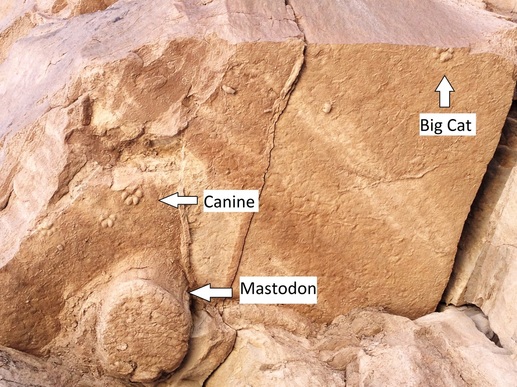
Thousands of sea shells were cemented into the sedimentary rock at our feet, remnants of the ancient inland sea that once existed here. Further up the wall, a curious sight protruded from younger rock strata. Familiar-looking animal tracks were imprinted on a ceiling of overhanging rock.
Over millennia, that silt solidified into rock, preserving the tracks. Much later, the softer underlying layer — the mud the animals walked through — eroded and fell away, revealing the ceiling of sculptured feet above us. These now-extinct animals visited this spot millions of years ago and, until this layer also erodes away, the evidence is clear to see today. Incredible!
Further along, we saw horse and camel prints. It turns out these animals are native to North America, but went extinct here after migrating to Asia. This place was once an inland sea, once teeming with large mammals, and is now a desert … our planet is one of change.
My revelation relates to our work here at Sonoma Land Trust. Things are changing faster than ever. In the last 50 years, the earth has lost half of its wildlife. In the Sonoma Valley, practically in our own backyard, many species are being pushed out of their native habitat by encroaching development.
Our Sonoma Valley Wildlife Corridor study is documenting which animals use this place, just as the fossilized rock in the desert recorded those canines, cats, mastodons, camels and horses from three million years ago.
Let’s make sure that future generations don’t have to look at old photos and talk about the mountain lions, black bears and porcupines who once lived here. Let’s continue to protect our open spaces so that future generations can explore the land and find fresh tracks of the magnificent animals who still make Sonoma Valley their home.