Blog
no weeds, fewer bees
by Julian Meisler
After Jen Stanfield’s excellent blog post two weeks ago about Bee Gate, I’ll continue with another bee-centered story.
Chances are that, if you are reading this, you are aware that honeybees face global declines from a variety of causes. While the disturbing losses attributed to colony collapse disorder (CCD) seem to have abated somewhat, colony failure in the U.S. was still over 40 percent in 2014−2015. Beekeepers consider losses above 18.7 percent to be economically unviable.
It is true that European honeybees are not native — but, without them, we’d be in a heap of trouble. That is why the lesson I learned at Sears Point several years ago has remained poignant.
Chances are that, if you are reading this, you are aware that honeybees face global declines from a variety of causes. While the disturbing losses attributed to colony collapse disorder (CCD) seem to have abated somewhat, colony failure in the U.S. was still over 40 percent in 2014−2015. Beekeepers consider losses above 18.7 percent to be economically unviable.
It is true that European honeybees are not native — but, without them, we’d be in a heap of trouble. That is why the lesson I learned at Sears Point several years ago has remained poignant.
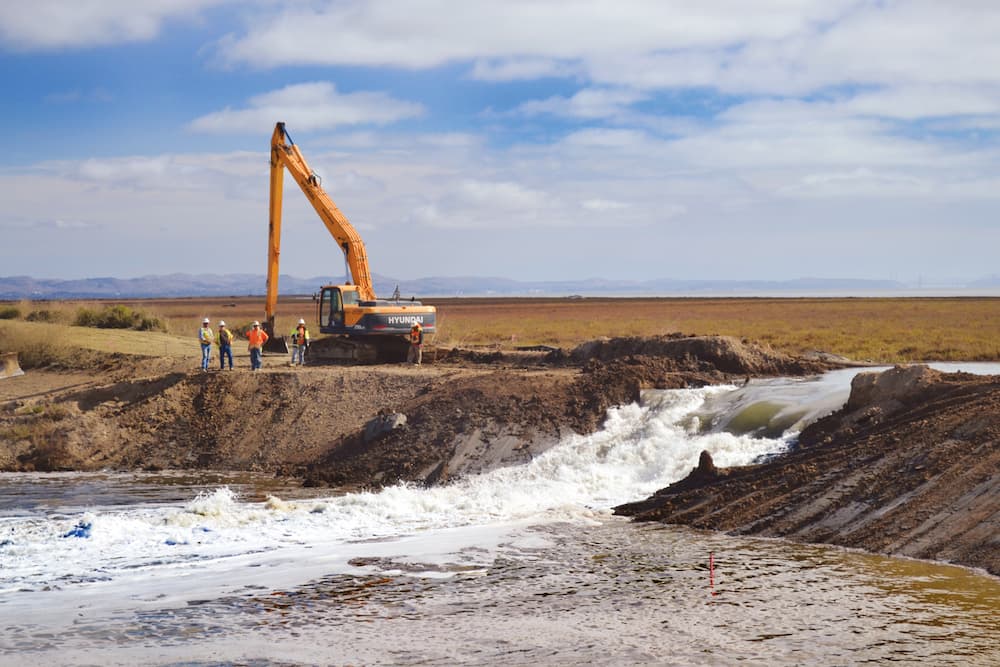
It was 2013 and we were beginning to prepare the site for its eventual tidal flooding. Among other things, we removed several barns and outbuildings and a home from the Dickson Ranch. The former owner, Fred Dickson, had informed me that there were four bee colonies inside the buildings — two in the home and one in another building. I wasn’t sure how best to proceed so I called one of our members with a great knowledge of bees, Serge Labesque.
I told Serge what we were planning and he volunteered to remove the colonies from the site. It was nearly fall and he let me know that there was no time to delay as the colonies would be preparing for winter. I was delighted to have a solution — but what happened next opened my eyes to something I’d never given adequate thought to before.
Serge found only two of the colonies and both were in very poor shape. My mind immediately went to CCD, but Serge countered that it was very difficult to pinpoint the problem. Many things could have weakened these bees and it was most likely a combination of multiple factors. In this case, he thought that they were starving. He asked me if anything had changed in the area that might have affected their access to nectar and pollen.
My heart sank. Yes, something had changed. While many acres of that land had been farmed for oat hay off and on for years, the fields were on a rotation. Fields that hadn’t been planted often had a variety of weeds in them, like fennel, yellow star thistle, bristly ox tongue and mustards. That year, I had allowed all the fields to be planted to oat hay one last time and virtually all of the weeds were gone, even along the roadsides. This meant that all of the bees’ food was gone.
Certainly bees must roam further in their constant search for sustenance, but I have to wonder if the removal of that nearby source could have harmed an already struggling colony. Of course, I’ll never know for sure. But with the paucity of late-blooming native forbs in our grasslands nowadays, there might be value in having a few weeds here and there.
I told Serge what we were planning and he volunteered to remove the colonies from the site. It was nearly fall and he let me know that there was no time to delay as the colonies would be preparing for winter. I was delighted to have a solution — but what happened next opened my eyes to something I’d never given adequate thought to before.
Serge found only two of the colonies and both were in very poor shape. My mind immediately went to CCD, but Serge countered that it was very difficult to pinpoint the problem. Many things could have weakened these bees and it was most likely a combination of multiple factors. In this case, he thought that they were starving. He asked me if anything had changed in the area that might have affected their access to nectar and pollen.
My heart sank. Yes, something had changed. While many acres of that land had been farmed for oat hay off and on for years, the fields were on a rotation. Fields that hadn’t been planted often had a variety of weeds in them, like fennel, yellow star thistle, bristly ox tongue and mustards. That year, I had allowed all the fields to be planted to oat hay one last time and virtually all of the weeds were gone, even along the roadsides. This meant that all of the bees’ food was gone.
Certainly bees must roam further in their constant search for sustenance, but I have to wonder if the removal of that nearby source could have harmed an already struggling colony. Of course, I’ll never know for sure. But with the paucity of late-blooming native forbs in our grasslands nowadays, there might be value in having a few weeds here and there.
Julian Meisler is Sonoma Land Trust’s Baylands program manager.