Blog
nature connections
by Ingrid Stearns
Running Sonoma Land Trust’s On the Land program, I find myself at the interface of humans and nature. My job is to design ways to get people into the outdoors to experience the places we have been working to protect. A basic premise is that when people directly experience a place, that personal connection helps bring the abstract ideas of land conservation into a tangible reality.
While we might not get to experience every inch of every area that we’ve put into protected status, our On the Land program brings people close enough to taste a variety of the landscapes and habitats that make up this amazingly diverse county — from redwood forests to coastal prairies, tidal marshes to oak woodlands, and on and on.
Recently I’ve been contemplating what brings people into the outdoors and what inspires people to take a walk with us. For some, it’s the opportunity to experience places they can’t otherwise see. For others, it’s the opportunity to learn something new about nature. And some people experience a deep nourishment from being in natural landscapes, away from the concerns of the world. Yet what I’m beginning to realize is one of the true values of our program is providing people the opportunity to connect with each other in the natural world.
While we might not get to experience every inch of every area that we’ve put into protected status, our On the Land program brings people close enough to taste a variety of the landscapes and habitats that make up this amazingly diverse county — from redwood forests to coastal prairies, tidal marshes to oak woodlands, and on and on.
Recently I’ve been contemplating what brings people into the outdoors and what inspires people to take a walk with us. For some, it’s the opportunity to experience places they can’t otherwise see. For others, it’s the opportunity to learn something new about nature. And some people experience a deep nourishment from being in natural landscapes, away from the concerns of the world. Yet what I’m beginning to realize is one of the true values of our program is providing people the opportunity to connect with each other in the natural world.
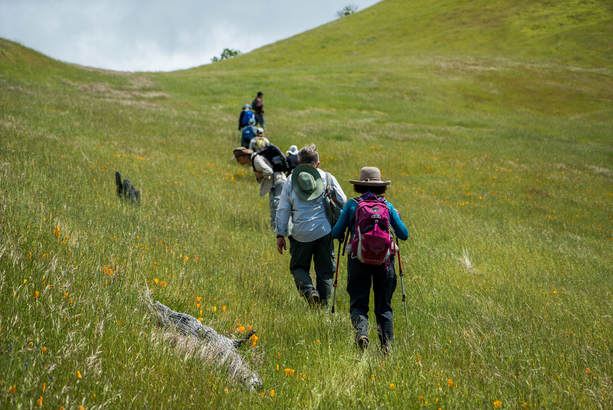
When we do our 10-mile hike up and over Pole Mountain, we usually start out by asking participants to tell us about their favorite mountain they’ve hiked, or their favorite natural place in Sonoma County, and we are always amazed at the combined experience of these avid hikers and nature-lovers. We’ve gathered all of these people together into one place to take them on a special journey. Over the course of those 10 miles, people get to know each other. Friendships are formed through this shared experience. So while we’ve experienced beautiful views and great exercise, we’ve done it in the company of conservation-minded peers. Not only have we deepened our sense of place within the context of nature, we have deepened our connections with other people who also help protect these places, whether through their votes, their dollars or their outreach.
This gathering of people, I am beginning to see, is one of the most valuable benefits of our On the Land program.
This gathering of people, I am beginning to see, is one of the most valuable benefits of our On the Land program.

In furthering that line of thinking, I was pondering the human connection to — and separation from — nature. In the separation paradigm, nature is something “other”— something outside of ourselves and something that we can choose to interact with or not; a place that we go outside of where we spend most of our time. But in the connection paradigm, humans experience themselves as a part of nature, something we can’t escape even if we tried. Our food, water, shelter and everything upon which we depend for our survival is in nature. Our very bodies are nature.
So in this paradigm of connectedness within nature, what would our On the Land program look like? What would it be like to have undeveloped nature be the container for our human interactions? What if the social interactions between humans were the main focus and they were integrated within the very fabric of the natural world? We wouldn’t be going places to experience something “other”— we would be returning to our natural place in the world and focusing on the things that make human life so rich. We would be eating together, playing together, enjoying spending time with each other and getting to know each other, all while breathing fresh air amongst living things.
I sometimes fall into the trap of thinking that my work is about connecting people to something they aren’t already connected to. But it’s more like a reawakening to that of which we are already a part. Watching the birds and hiking to a mountaintop can be things that help us remember that connection, but having a picnic in a meadow can be just as valuable in bringing about that authentic experience.
Perhaps we can go on a picnic together someday.
So in this paradigm of connectedness within nature, what would our On the Land program look like? What would it be like to have undeveloped nature be the container for our human interactions? What if the social interactions between humans were the main focus and they were integrated within the very fabric of the natural world? We wouldn’t be going places to experience something “other”— we would be returning to our natural place in the world and focusing on the things that make human life so rich. We would be eating together, playing together, enjoying spending time with each other and getting to know each other, all while breathing fresh air amongst living things.
I sometimes fall into the trap of thinking that my work is about connecting people to something they aren’t already connected to. But it’s more like a reawakening to that of which we are already a part. Watching the birds and hiking to a mountaintop can be things that help us remember that connection, but having a picnic in a meadow can be just as valuable in bringing about that authentic experience.
Perhaps we can go on a picnic together someday.

Ingrid Stearns is outings manager for Sonoma Land Trust.