Blog
A season for fire: In nature, timing is everything
An experienced gardener may tell you there is a right time to prune or plant their crop. Similarly, land managers who use prescribed fire are thoughtful about how and when to burn. The goal is to maximize the benefits of prescribed burning while minimizing potential impacts on the ecosystem or surrounding communities.
Prescribed fire practitioners burn select areas for three main reasons:
- To decrease the risk of more dangerous fires;
- To improve the health of habitats for native plants and animals by clearing away a portion of live and dead vegetation; and
- To manage invasive species.
But how do prescribed fire managers choose when to burn a given area? The answer depends on the particulars of the location, and the exact goals.
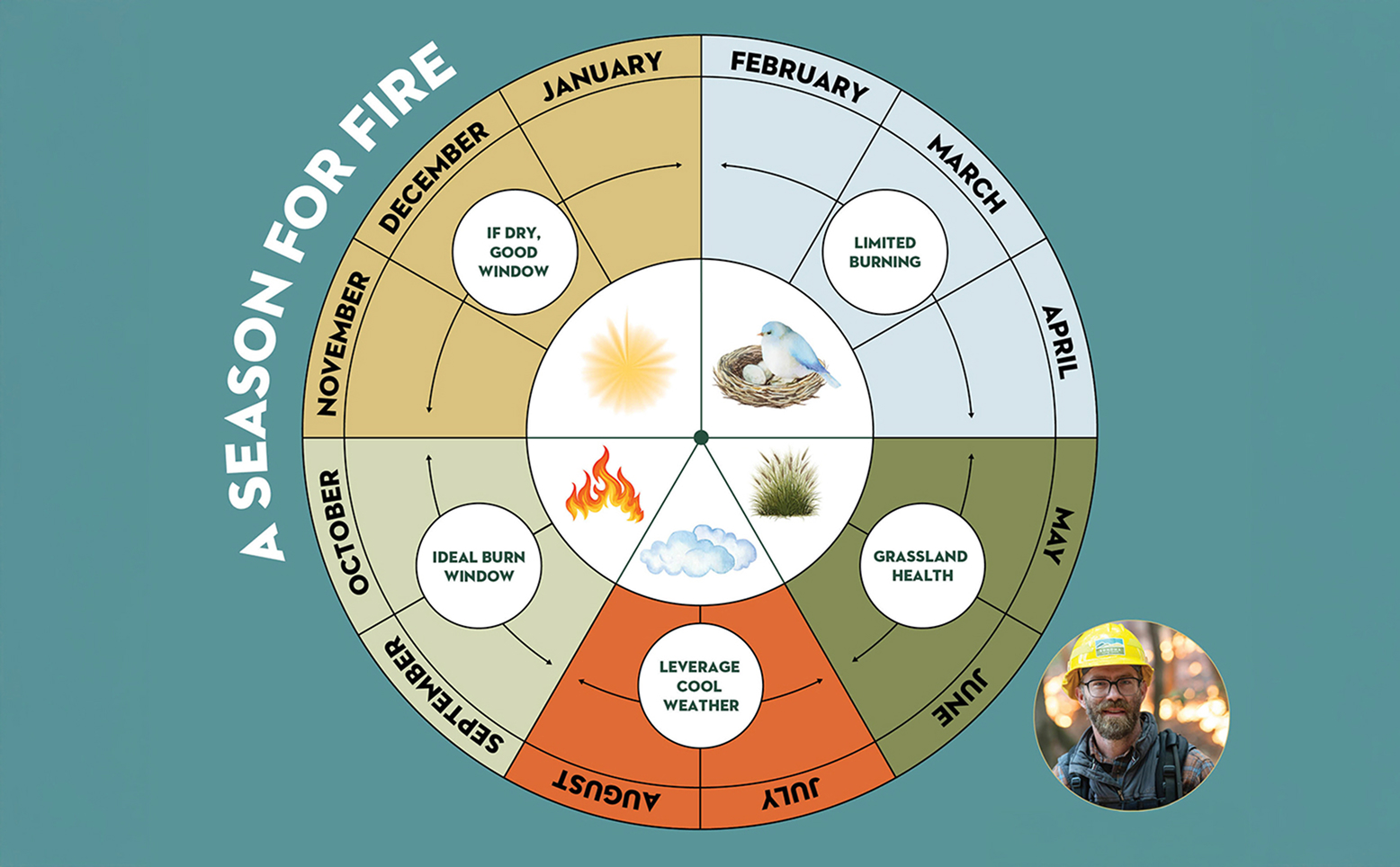
Between February and April, it is not a great season for bringing intentional fire to the land. Tall green grass and damp forest fuels (from logs, leaves, and sticks) equate to a lot of wet material. It’s hard to burn damp fuels–and even if you manage to get them going, wet fuels tend to produce a lot of smoke. This is also the season of nesting birds, migrating salamanders, and blooming plants, which are protected under state law. If a burn must happen in this window, pile burning is the way to go, only after surveying for nesting birds.
In the spring, from May through July, prescribed fire can help reduce invasive species in grasslands. For example, by timing the burns to match the development of invasive species, some of which flower later than native plants, land managers can control plants like yellow star thistle or medusahead grass, while protecting native species whose seeds have already lodged themselves deep into the seed bank. In addition to nourishing native habitat quality, grassland burns enhance community wildfire resilience by burning fuels that do not re-grow until the end of fire season.
July through August can be an excellent period for prescribed fire only if the conditions are right. In some cases, prescribed burns need enough heat to sufficiently knock back encroaching shrubs. This is especially relevant for improving coastal prairie habitat. Of course, not every window in the summer is a good time to burn–heatwaves, windstorms, and stagnant air rightly delay many burn projects. Burn managers coordinate with air quality and fire agencies to ensure that burning only occurs when public health and safety can be protected.
In the fall, from September through November, can be tricky for planning a prescribed burn. But after rains come, this can be one of the best windows to get fire on the ground. Although fall brings a greater potential for off-shore wind events, and smoke is a concern for grapes, this is the season when historically, fires burned large areas. As such, plants and animals are the most adapted to fire during this period of time, over any other. Fire during this time can clear grass and leaves, and can help reduce acorn weevil populations, giving acorns a better chance to grow into the next generation of oaks.
Lastly, November through January can be a great season for burning, provided the conditions are right. Pile burning is at its’ best, and if you cover your piles with wax paper, they should remain dry in the middle, while surrounding fuels are too wet to burn. Swaths of tall, dead grass thatch can be burned off too, helping revitalize meadows and rangeland. If dry, leaf litter can be burned, with less concern for nesting creatures or damage to fire-scarred trees.
Rain, winds, stagnant air, or a big wildfire somewhere might cancel any plans for good fire. We are working with the elements to the best of our abilities. Utilizing windows of time for safe and effective burning is vital for long-term ecological and communal resilience as we work to protect lands and people from the worst impacts of future, unwieldy wildfires.