Blog
everything’s coming up weeds
by Trevor George
Weed populations on Sonoma Land Trust’s preserves appeared blackened and devastated after the fire, along with everything else. Fire burns without prejudice, and will clear out native and invasive species alike. However, just as the native species respond and regrow, so do the invasive species we work hard to manage. In some cases, the fire has given us an advantage against these species, while making it more difficult in others.
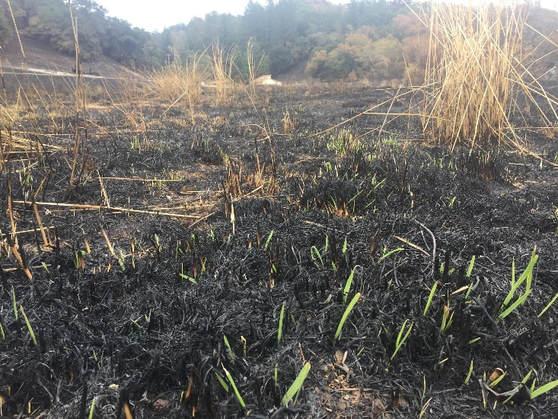
Some invasive species are well adapted to fire and even flourish with it. Harding grass (Phalaris aquatica), pictured below, has deep roots and was one of the first grasses to bounce back after the fire. This plant got a head start and is likely to continue outcompeting other native grasses.
Some invasive species are well adapted to fire and even flourish with it. Harding grass (Phalaris aquatica), pictured below, has deep roots and was one of the first grasses to bounce back after the fire. This plant got a head start and is likely to continue outcompeting other native grasses.
Harding grass sprouting after the fires.
Some weeds need disturbance and the fire gives them the perfect opening to take hold. At Sears Point, yellow star-thistle (Centaurea sostitialis) has colonized some of the land where the grass burned. A persistent seed bank and disturbance event have allowed this species to flourish and stewardship staff are working hard to develop a treatment plan.

Check out the long taproot on this yellow star-thistle. It’s the reason it can continue growing through the dry season while the grasses dry out.

The above photo shows a large, dense patch of Armenian blackberry that burned in the Tubbs fire at Live Oaks Ranch — a common sight on the property. The plant is not dead and has begun to sprout back. Attempting to remove this patch prior to the fire would have been costly and time intensive. However, with much of the work already done by the fire, we’ll have a much easier time removing the new growth of the plant. We now have a chance to treat this previously unmanageable patch of blackberry.
Before the fire, the cattle that graze at Live Oaks Ranch liked to hang out in the shade under certain oak trees. The manure they produce provides excess nitrogen that some varieties of thistle thrive on. These thistle plants established themselves in small groups in a ring-like formation around the tree where the cattle spend their time. With an extra ashy flush of nitrogen after the fire, thistle populations ballooned into much larger infestations. We’re considering treatment options for these, but they may shrink naturally as nutrients in the system go back to pre-fire levels.
Before the fire, the cattle that graze at Live Oaks Ranch liked to hang out in the shade under certain oak trees. The manure they produce provides excess nitrogen that some varieties of thistle thrive on. These thistle plants established themselves in small groups in a ring-like formation around the tree where the cattle spend their time. With an extra ashy flush of nitrogen after the fire, thistle populations ballooned into much larger infestations. We’re considering treatment options for these, but they may shrink naturally as nutrients in the system go back to pre-fire levels.

On the left, I’m standing in a patch of thistle that has expanded after the fire. Sonoma Land Trust hikers are standing in the grassy pathway to the right.
We continue to battle with many other weeds, some of which have become much more difficult to control. The fight against weeds has changed on our fire-affected preserves. We’re making progress using the advantages given by fire, but we’re working extra hard to combat species that benefited from it before their populations expand exponentially. We primarily control weeds to promote native biodiversity, but weeds can also lead to more damaging and more frequent fires. When it comes to wildfire, our weed management efforts help promote a more resilient landscape and safer community.
Trevor is one of the Land Trust’s stewardship project managers. He oversees the activities on our Russian River Watershed preserves in the northern part of Sonoma County. Trevor loves the rugged, wild terrain of this region and enjoys experiencing it while struggling up hills on a bike or chasing his crazy dog.