Blog
celebrating change we don’t see
by Bob Neale
Our world is so busy now that it is often difficult to take a moment to breathe, to take a moment to step back and look at the big picture or see the results of our work. Last week I was out at Tolay Creek Ranch counting how many trees were alive in the lower stretch of the creek. As the day was progressing, I realized that I had been working on restoring that lower section of creek for more than 10 years — a decade of oak trees, creeping wild rye and children planting seedlings (and ticks, poison oak and sunburns…).
The reason I was counting the trees is that the number of trees that lived is one of our primary metrics for success. But our work out there is so much more than just the trees we planted. It involves changing behavior, like how the cattle are managed and how the landscape responds. It involves coping with things we can’t control, like drought and floods, and the changes these natural events bring to the landscape. I started thinking about what change had actually occurred and I realized I couldn’t exactly remember those first visits I made in 2006 and 2007 and what Tolay Creek looked. Like the face of my daughters over the years, I knew the creek had changed; it was different. I couldn’t exactly say how it was different, just that it is.
So when I returned to the office I looked for photos of those early days and was stunned — in a good way. So I thought I’d share:
The reason I was counting the trees is that the number of trees that lived is one of our primary metrics for success. But our work out there is so much more than just the trees we planted. It involves changing behavior, like how the cattle are managed and how the landscape responds. It involves coping with things we can’t control, like drought and floods, and the changes these natural events bring to the landscape. I started thinking about what change had actually occurred and I realized I couldn’t exactly remember those first visits I made in 2006 and 2007 and what Tolay Creek looked. Like the face of my daughters over the years, I knew the creek had changed; it was different. I couldn’t exactly say how it was different, just that it is.
So when I returned to the office I looked for photos of those early days and was stunned — in a good way. So I thought I’d share:
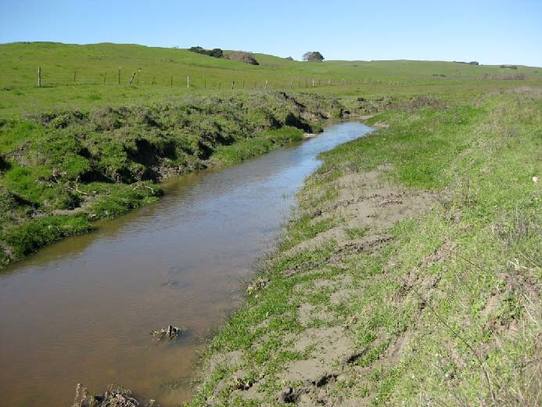
Here is Tolay Creek around 2008.
And here it is just last week in the same spot.

The willows we planted are happily growing, and so is the creeping wild rye, the meadow barley and salt grass that we didn’t plant. With no cattle trampling up and down, the formerly bare and eroding streambanks have stabilized and are now covered with vegetation, a healthy portion of which is native grasses, reeds and sedges that have recolonized by themselves.
Further up creek, counting a living valley oak tree we planted about eight years ago, we spied some wildlife that had taken up residence, using the new tree for habitat and a place to safely breed and thrive.

The floods following the drought have noticeably widened the creek in some places, deepened the channel in others, and filled in other places. Valley oak trees are growing now — 225 of them we planted. At least as many have planted themselves.
I spent a good long time jumping between photos I’d taken over the years: before, during, and now. And I felt happy, like when my youngest daughter graduated from college this June. I couldn’t count the phases, days or number of smiles or tears that had occurred over the years, but there before us all she stood confident, healthy and ready for the future. Out at Tolay Creek, this land that has been teaching me so much the past decade — land that I’ve cared for and fussed over — is now healing and growing, even thriving. Nature is a powerful and enduring force that finds its own way. So, I can’t take credit for these wonderful outcomes. And so many other people have been involved at Tolay Creek Ranch: Glen, our rancher; Isaiah and his team from Point BlueFederated Indians of Graton Rancheria

I spent a good long time jumping between photos I’d taken over the years: before, during, and now. And I felt happy, like when my youngest daughter graduated from college this June. I couldn’t count the phases, days or number of smiles or tears that had occurred over the years, but there before us all she stood confident, healthy and ready for the future. Out at Tolay Creek, this land that has been teaching me so much the past decade — land that I’ve cared for and fussed over — is now healing and growing, even thriving. Nature is a powerful and enduring force that finds its own way. So, I can’t take credit for these wonderful outcomes. And so many other people have been involved at Tolay Creek Ranch: Glen, our rancher; Isaiah and his team from Point BlueFederated Indians of Graton Rancheria

As stewardship director, Bob works with a team of dedicated professionals to care for and manage the Trust’s lands and conservation easements. He grew up in southern California, watching the fields and beach front slowly disappear to condos, mansions and strip malls. Fleeing the concrete, Bob moved north and received his B.A. in English with a concentration in creative writing from San Francisco State. Bob worked in the freight industry for several years until he finally decided to bring his attention back to his first love – the land. Beginning at Peninsula Open Space Trust, and then moving to Sustainable Conservation, he was fortunate to work with and learn from some of the most creative people in conservation, and continues to do so at SLT