Blog
an uncommonly ‘common’ find
by Tony Nelson
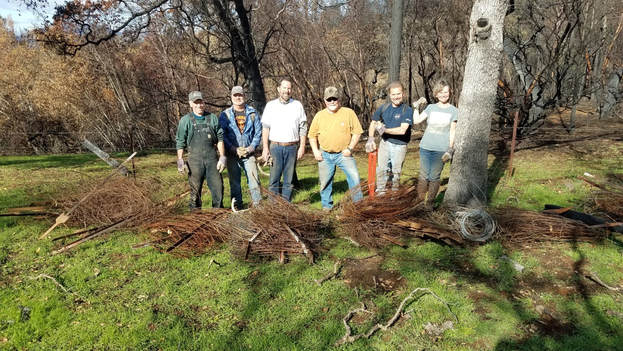
One of the most satisfying tasks in land management, for me, is removing fence. Much of our work stewarding land and resources requires a very long view. Often we do good things knowing that we aren’t likely to see the full benefits ourselves. Taking out fence, though, provides immediate gratification. While we can see the old materials piled up to be taken away, the aesthetic transformation on the landscape is incredible. The more one takes notice of fences, the more one sees. They’re everywhere and they create psychological as well as physical barriers. Not all fences are bad, of course, and we need them to manage livestock and people. But they have unintended consequences for wildlife so I love taking fence out when it’s not necessary. Our volunteers like taking fence out for the same reasons — which is why a group of volunteers and staff took out three old fence lines (2,350 feet!) at Glen Oaks Ranch this past Tuesday.
Volunteers after a successful day of removing old fencing: (L to R) Lou Gouveia, Todd Board, Mark Charnas, SLT staffer Tom Tolliver, Eric Fessenden and Shelley Simmons. Not pictured: Hugh Black, Sandy Stoddard, Joe Riedel. Photo by Kate Freeman
Because of the fire, access was easier than it would have otherwise been and — halleluiah! — no poison oak!
Our volunteers Lou and Eric had a nice surprise up near the Manzanita loop trail. When they went to pick up a piece of tangled wire, they found this little puffball sitting inside:
Our volunteers Lou and Eric had a nice surprise up near the Manzanita loop trail. When they went to pick up a piece of tangled wire, they found this little puffball sitting inside:

Photo by Eric Fessenden
It’s a common poorwill (Phalaenoptilus nuttallii)* — thankfully, Lou and Eric were carefully looking around before handling the wire so they were able to extricate it safely. It doesn’t look like much of a hawk, but that mostly hidden beak is effective at snatching insects which, as the name implies, occurs mostly at night. This one seems to be a juvenile as there is no white throat patch visible, but maybe it’s hidden because the feathers are poofed up (official birding terminology).

Photo by Eric Fessenden
They will roost on the ground at times and it’s said that they are one of the few bird species known to inhabit recently burned forested areas. According to the 1995 Sonoma County Breeding Bird Atlas survey (an update is in progress) “the common nighthawk is not common in Sonoma County even though it is North America’s most widespread nightjar.” Lou and Eric made a very cool find.

Photo by Eric Fessenden
*Correction January 29, 2018
The original blog post misidentified this bird as a common nighthawk.
The original blog post misidentified this bird as a common nighthawk.
A note from Tony:
“It’s been a long time since I focused on bird id and it can be tricky distinguishing similar species in photos. I asked the birder friend that I consulted and she said that she thought the tail seemed too long to be a poorwill and that poorwills had a more distinctive white throat patch. But she also didn’t realize that poorwills sometimes winter in Central Ca, and with your input agreed that poorwill is a more likely occurrence at Glen Oaks right now, and that nighthawks are more likely migratory in this region. Apologies for the false id!”
Tony Nelson is Sonoma Land Trust’s Sonoma Valley program manager.