Blog
a squirrely investigation
by Trevor George
When I was in college at Sonoma State, I had a roommate who had just moved into the dorms from Hawaii. He had rarely, if ever, been to the mainland and chose Sonoma County for his big adventure away from home. He would do some of the things you might expect for someone fresh out of tropical Hawaiian paradise, such as walking to class in a thick parka, gloves and hat on a sunny, 65 degree day, and he would cook with Spam occasionally. But one difference in perspective that I had not expected was illustrated the first time he saw a squirrel.
“Whoa, is that a squirrel?! It’s a squirrel! Check this out! Did you see him?!”
“Whoa, is that a squirrel?! It’s a squirrel! Check this out! Did you see him?!”
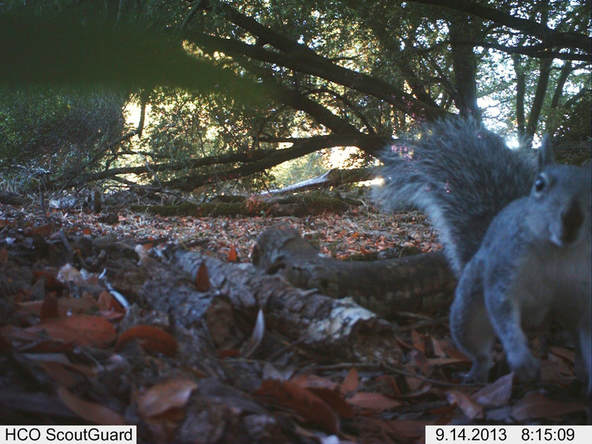
Western gray squirrel (Sciurus griseus) on one of our wildlife cameras.
While my roommate was disappointed that I had missed this rare opportunity to experience wildlife (it ran off behind some trees), he was surprised when I informed him that I’d seen hundreds if not thousands of them — they’re everywhere. You might see or hear one as you read this. It turns out they don’t have squirrels in Hawaii, so these curious creatures were quite a sight for him. They provided endless entertainment throughout the campus for my friend over the next four years.
The perspective check that I got from my roommate has given me perhaps an ounce more appreciation for squirrels. There are four common tree squirrels in California: Eastern fox squirrels and eastern gray squirrels were brought over from parts of the eastern United States, and western gray squirrels and Douglas squirrels are native here. The western gray squirrels are what I most frequently encounter on our oak woodland dominated preserves, and the eastern species may be what you’re pulling your hair out over in your backyard. The western gray squirrel tends to avoid human contact, while the eastern gray squirrel is comfortable in urban environments. Identification between these squirrels can be tricky, but the western ones have the puffiest tails.
The perspective check that I got from my roommate has given me perhaps an ounce more appreciation for squirrels. There are four common tree squirrels in California: Eastern fox squirrels and eastern gray squirrels were brought over from parts of the eastern United States, and western gray squirrels and Douglas squirrels are native here. The western gray squirrels are what I most frequently encounter on our oak woodland dominated preserves, and the eastern species may be what you’re pulling your hair out over in your backyard. The western gray squirrel tends to avoid human contact, while the eastern gray squirrel is comfortable in urban environments. Identification between these squirrels can be tricky, but the western ones have the puffiest tails.
Whoa, is that a squirrel?! It’s a squirrel! Check this out! Did you see him?!


That tail enables tree squirrels to do some pretty neat things. They use it to hug trees as they climb or wave it around to signal danger, and they can use it as a blanket to keep warm in their nest or tree cavity. It also helps them navigate as they run at speeds of up to 15 miles per hour. In the unlikely event that they lose grip on a tree trunk, the tail can create a parachute effect to reduce the impact of a fall.
Both western and eastern gray squirrels eat a variety of nuts, seeds and fruits. You’ve probably seen them hard at work burying their hard-earned acorns for another day. It’s true that squirrels may leave behind nuts that grow into trees, helping trees reproduce, but let’s not call squirrels forgetful just yet. Studies have shown that squirrels use their memory and strong sense of smell to recover a high percentage of their buried food. The ones they do leave behind may be because they were planning for a longer winter than they needed to. There’s even evidence to suggest that squirrels create false caches to trick neighboring squirrels and other critters who would seek out their precious nuts — clever creatures!
It’s easy to ignore some of the things we see every day, and sometimes it takes a nudge from someone outside our norm to spark a little appreciation. Nothing in nature is simple — it’s worth the second look.
Both western and eastern gray squirrels eat a variety of nuts, seeds and fruits. You’ve probably seen them hard at work burying their hard-earned acorns for another day. It’s true that squirrels may leave behind nuts that grow into trees, helping trees reproduce, but let’s not call squirrels forgetful just yet. Studies have shown that squirrels use their memory and strong sense of smell to recover a high percentage of their buried food. The ones they do leave behind may be because they were planning for a longer winter than they needed to. There’s even evidence to suggest that squirrels create false caches to trick neighboring squirrels and other critters who would seek out their precious nuts — clever creatures!
It’s easy to ignore some of the things we see every day, and sometimes it takes a nudge from someone outside our norm to spark a little appreciation. Nothing in nature is simple — it’s worth the second look.
Trevor George is a stewardship project manager at Sonoma Land Trust.