It’s Independence Day week and for most people that means celebrating with fireworks. While I too enjoy the site of colorful exploding missiles in the night sky, I often find myself questioning a tradition that produces both chemical and noise pollution. California hosts many naturally occurring phenomena that are as equally awe-inspiring as fireworks. Below I will introduce you to a few glowing alternatives that do not involve gunpowder (I recognize that the pyromaniacs have checked out already).
If you enjoy glow sticks, starry skies or glitter, then you will undoubtedly be enchanted by bioluminescence, which is the biochemical emission of light by living organisms. This spectacle is found in many marine organisms, such as bacteria, algae, jellyfish, crustaceans, seastars, fish and sharks (most of these are deep sea dwellers).
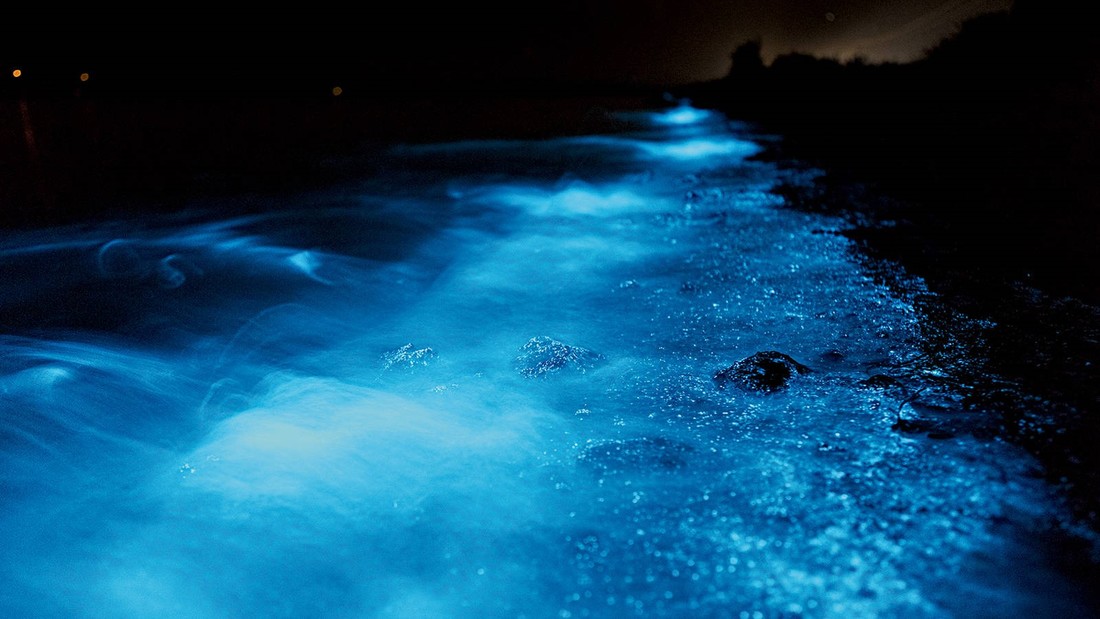
Is the chandelier firework what you’re after this holiday? Then I highly recommend getting your phosphorescent-fix somewhere along the coast. Head to Tomales Bay where single-celled organisms called dinoflagellates float near the water’s surface. Mechanical agitation — i.e., by a boat, a hand or the surf — causes a reaction resulting in a burst of bright blue light. When concentrations of dinoflagellates are high and waters are calm, you might witness a full-on aquatic firework display.
Do you find yourself seeking a good ol’ fashioned bottle rocket? If a quasi-hallucinogenic trip through the bay isn’t your cup of tea, perhaps the sight of a glowing echinoderm might fill the explosive niche within you. Bioluminescence is common among echinoderms (sea stars, brittle stars, sea urchins, sand dollars, sea cucumbers). The luminous brittle star Amphipholis squmata has a wide geographic distribution and can be found in the Bay Area. Some brittle star species drop a flashing limb when attacked to distract predators as they escape.
The luminous brittle star Amphipholis squmata.
If exploring the ocean depths isn’t on your agenda, fear not — there are terrestrial organisms that glow! And what says “Happy Independence Day, America” more than a toxic glow-in-the-dark millipede? There are a handful of bioluminescent millipede species in the genus Motyxia found in woodlands of the southern Sierras. When these creatures emerge from underground at night, they emit a neon glow produced by a photoprotein. This is thought to be a signal of toxicity to predators. Beware — these millipedes release cyanide when threatened and may be slightly more menacing than the firecrackers of your childhood.
A toxic glow-in-the-dark millipede Image: edenpictures via photopin cc
Not so enthralled by radiant, toxic creepy crawlers? How about an innocuous beetle to satiate your inner pyrotechnic? Lampryidea are a family of glowing insects whose star player is the firefly. While California doesn’t host summertime firefly raves — this type of debauchery only occurs east of Kansas — it would be false to say that there are no fireflies in our state. About 18 species of fireflies live in California, most of which either glow very dimly or are only bioluminescent in the larval stage. However, anyone seeking something a bit spicier than a sparkler may be intrigued by the California Pink Glowworm (Microphotus angustus). Females are the light-emitter of this species. They spend their entire life in the larval form and use their light organs to attract males.
Not an animal person but still want to be a fun guy* this holiday? Bioluminescent fungi are the perfect replacement for that roman candle! The Western Jack O’Lantern mushroom (Omphalotus olivascens) is similar in appearance to a chanterelle, but has gills that fluoresce. Omphalotus species grow on wood and illuminate the area on the trunk from which they grow. While Jack O’Lantern mushrooms aren’t perhaps as effective as roman candles in scaring off your pesky in-laws, they are poisonous, so don’t try throwing them on the grill for you requisite BBQ this week!
*in the gender-neutral sense
The Western Jack O’Lantern mushroom.
Kate Freeman is stewardship assistant project manager for Sonoma Land Trust.