Blog
make way for red-legged frogs
by Julian Meisler
These days, when we think of Sears Point, the tidal wetland restoration comes to mind. But the uplands at Sears Point — the land above the historic edge of San Pablo Bay and north of Highway 37 — hold some incredible resources and opportunities as well. There, we’ve been working on a variety of enhancement and restoration projects for years.
In her blog post a few weeks ago, Nicole Na wrote about the burrowing owls using the artificial burrows that we installed in these uplands. Although we haven’t yet seen the owls breeding there, we still remain hopeful.
Burrowing owls are not the only species we hope to lure back to the site for breeding. A few years ago, we built three seasonal ponds designed specifically to serve as breeding sites for threatened California red-legged frogs (Rana draytonii). When designing the ponds, we took into account some basic life history of red-legged frogs and one of their primary competitors and predators — non-native American bullfrogs (Lithobates catesbeianus). The gist is this: Both bullfrogs and red-legged frogs lay eggs in winter, but bullfrog tadpoles generally require an entire year before transforming from tadpole to frog. Red-legged frogs, on the other hand, transform in the same year. Therefore, for a bullfrog tadpole to survive to adulthood, the pond must stay permanently inundated.
In her blog post a few weeks ago, Nicole Na wrote about the burrowing owls using the artificial burrows that we installed in these uplands. Although we haven’t yet seen the owls breeding there, we still remain hopeful.
Burrowing owls are not the only species we hope to lure back to the site for breeding. A few years ago, we built three seasonal ponds designed specifically to serve as breeding sites for threatened California red-legged frogs (Rana draytonii). When designing the ponds, we took into account some basic life history of red-legged frogs and one of their primary competitors and predators — non-native American bullfrogs (Lithobates catesbeianus). The gist is this: Both bullfrogs and red-legged frogs lay eggs in winter, but bullfrog tadpoles generally require an entire year before transforming from tadpole to frog. Red-legged frogs, on the other hand, transform in the same year. Therefore, for a bullfrog tadpole to survive to adulthood, the pond must stay permanently inundated.
|
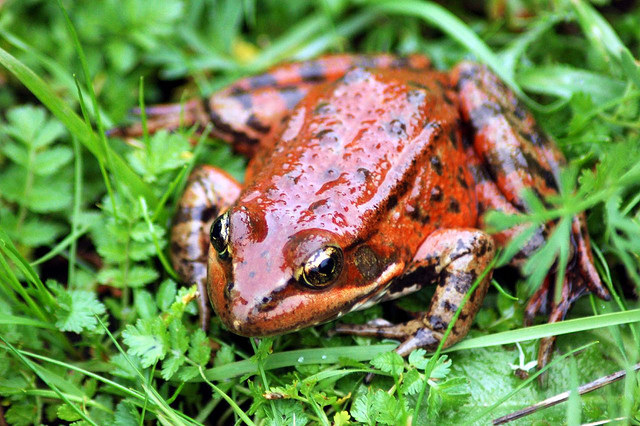
Red-legged frog (KQED via Bay Nature)
|

American bullfrog.
|
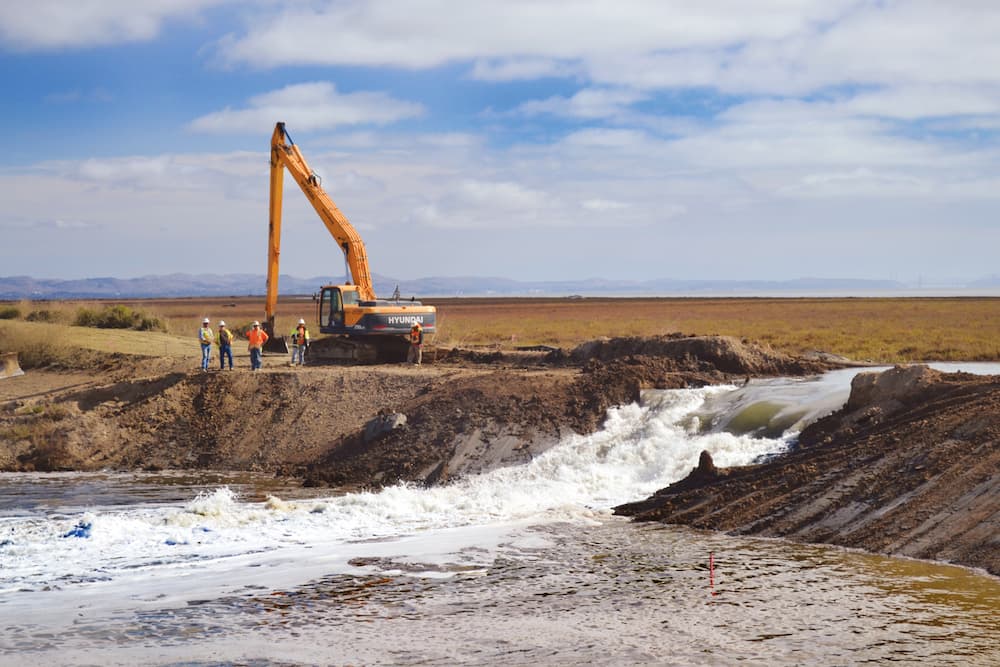
Before construction, we monitored potential pond sites for three years to determine how far the groundwater level drops in summer. Amazingly, water levels dropped at least five feet and as much as eight feet. With that in mind, we constructed our ponds to have a depth of no more than five to eight feet, depending on their location, ensuring that each pond will dry out each year.
Before construction, we monitored potential pond sites for three years to determine how far the groundwater level drops in summer. Amazingly, water levels dropped at least five feet and as much as eight feet. With that in mind, we constructed our ponds to have a depth of no more than five to eight feet, depending on their location, ensuring that each pond will dry out each year.

A pond in its first year of construction.
In the winter of 2012–2013 — the first winter after construction — the ponds filled with water, but were still devoid of vegetation essential for cover. Nevertheless, Sierran treefrogs (Pseudacris sierra), Sonoma County’s most common frog, and bullfrogs did colonize the ponds that winter. But the hydrology worked as planned. The treefrogs made it, the bullfrogs did not. Several years of drought followed and red-legged frogs remained absent from our ponds.

A Sierran treefrog (californiaherps.com)
Last week, I visited the ponds and they are full and beautiful. The efforts of several volunteer planting days in years past are evident, with willows, rushes and spikerushes flourishing. Water plantain and cattail have also made a strong showing. All of this is suggestive of optimal red-legged frog habitat. While I’ve not seen any yet, I’ve not yet formally surveyed the pond this year. I remain optimistic and patient and am satisfied when I hear the calls of the treefrogs. After all, we’ve all seen previously common species decline during our lifetimes. These ponds are for all amphibians, though we will blow an extra horn when the red-legged frogs arrive.