Blog
the secret life of opossums
by Tony Nelson
Opossums (not possums or opossomi) are curious creatures. The only marsupials in North America, they have opposable “thumbs” on their hind feet to help them climb and prehensile tails that help them cling to trees. They eat just about anything, including dead animals, rodents, amphibians, snails and slugs, plants and fruit. They are apparently mostly immune to snake venom — and have partial or total immunity to rabies, which makes them an okay critter to occasionally have in the yard.
We all know that they will ‘play possum’ (or ‘play opossum’) when threatened, but that seems to be a last resort. According to one source, they’ll also run (is there a predator that can’t outrun an opossum?), growl, belch, urinate and defecate. When playing dead, they roll over, stiffen, bare their teeth, foam at the mouth and secrete a foul odor. Utilizing bodily functions so readily to make themselves unappealing leads us to think of them as dirty, smelly things, but it’s a pretty effective adaptation for defense.
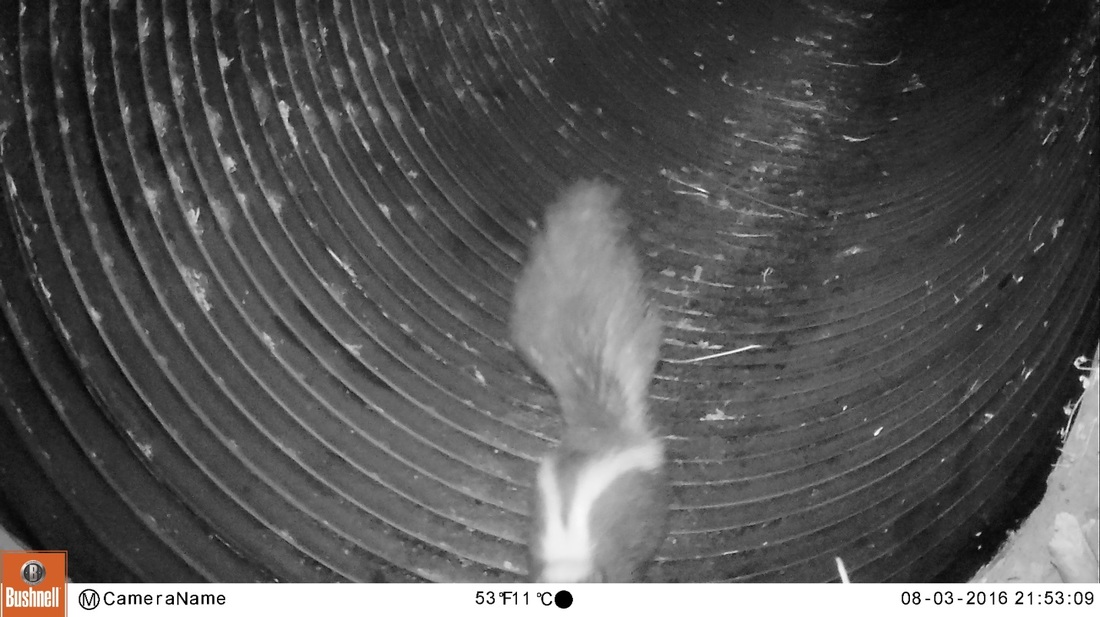
According to the National Opossum Society, these animals are typically gentle and placid, and tend to avoid confrontation. That was my understanding as well, which makes a recent encounter — captured on cameras that Sonoma Land Trust and our partner, Pathways for Wildlife, installed recently — all the more interesting.
We all know that they will ‘play possum’ (or ‘play opossum’) when threatened, but that seems to be a last resort. According to one source, they’ll also run (is there a predator that can’t outrun an opossum?), growl, belch, urinate and defecate. When playing dead, they roll over, stiffen, bare their teeth, foam at the mouth and secrete a foul odor. Utilizing bodily functions so readily to make themselves unappealing leads us to think of them as dirty, smelly things, but it’s a pretty effective adaptation for defense.
According to the National Opossum Society, these animals are typically gentle and placid, and tend to avoid confrontation. That was my understanding as well, which makes a recent encounter — captured on cameras that Sonoma Land Trust and our partner, Pathways for Wildlife, installed recently — all the more interesting.
A skunk approaches the opening of a culvert under a busy road …
A skunk approaches the opening of a culvert under a busy road …
Out of nowhere, an opossum attacks!

Skunk retreats, with opossum pushing forward … slowly …
Skunk retreats, with opossum pushing forward … slowly …

We don’t know what sent this stocky marsupial into a frenzy. Maybe there was roadkill nearby that it wanted for itself, or it had some young nearby to protect (like opossums, skunks have a varied diet, so maybe a small opossum was on the menu). Regardless, it’s an unusual display of ferocity, all the more remarkable because other animals typically give skunks a wide and well-earned berth. A recent study in Ecology by Maximilian L. Allen et al. found that skunks were the most frequent victors, along with bobcats, in many encounters with other mid-size meat- and carrion-eaters. They even witnessed a skunk stealing the meal of a puma (which is nearly 100 times the size of a skunk!). Clearly, that mountain lion and most of the other animals encountered in their study had had previous experiences with a skunk’s defense mechanism.
Perhaps this particular opossum hadn’t had the pleasure of being sprayed by a skunk yet and didn’t know any better. Or maybe the opossum’s defenses just make it one character that skunks can’t top. Opossums might be so stinky to begin with that they don’t care about getting zapped by a skunk. Don’t tell the National Opossum Society folks I said that. I like opossums, really — and I like them even more now.
Tony Nelson is Sonoma Land Trust’s Sonoma Valley program manager.